


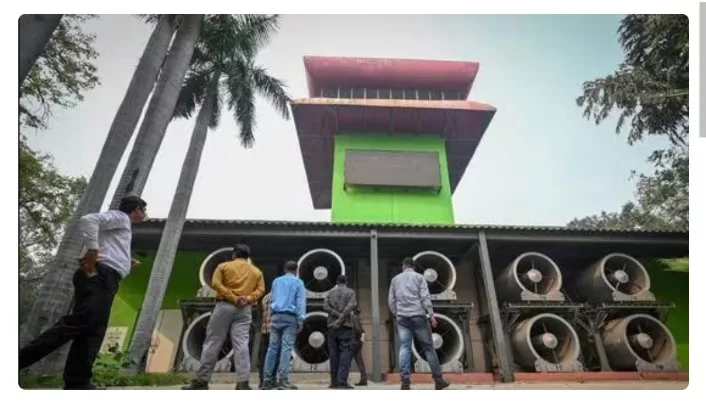
In a recent development, a report by IIT-Bombay has cast a shadow over the effectiveness of Delhi’s much-anticipated smog tower at Connaught Place, revealing a less-than-impressive impact on air quality. Despite a hefty investment of ₹25 crore and the Supreme Court’s directive to activate the colossal 24-meter air purifier, the report suggests that the benefits are most pronounced within a mere 20-meter radius, diminishing as one moves farther away.
The study indicates an 18% improvement in dust and ultrafine particulate matter roughly 500 meters downwind from the tower. However, this marginal enhancement raises concerns, especially considering Delhi’s perilously high PM2.5 concentration levels. Even under the best-case scenario, standing 500 meters away still exposes individuals to air quality well beyond safe limits.
Experts weigh in on the report, emphasizing that such smog towers, while possibly useful in specific locations like hospitals to reduce localized exposure, are far from being comprehensive solutions to Delhi’s pervasive pollution problem. The need to address emission sources directly is highlighted as a more sustainable approach.
The IIT-Bombay report delves into operational challenges, recommending seasonal activation due to negligible impact in summer months. Furthermore, it suggests scaling down future prototypes for enhanced maintenance efficiency and cost-effectiveness. The report underscores the tower’s limited reach and potential impediments from high winds and surrounding structures, questioning the practicality of its widespread application.
While the report estimates a benefit to approximately 19,500 people within a .78 square km radius, it fails to account for the tower’s roadside location rather than a densely populated settlement, potentially skewing its impact assessment. Concerns about clogged filters, air leaks, and the need for system re-engineering are raised, prompting a call for rigorous cost-benefit analyses.
In essence, the smog tower, once heralded as a panacea for Delhi’s air quality woes, now faces scrutiny for its restricted effectiveness, raising pertinent questions about the viability of such solutions in combating the city’s chronic pollution challenges.