



In a relentless crackdown on dissent within Belarus, musicians from the renowned Tor Band, which had become a symbol of protest in the country, have been handed prison sentences of up to nine years, marking a grave development in the nation’s ongoing suppression of opposition.
Tor Band garnered widespread recognition in Belarus amid the wave of protests that erupted in August 2020, following a disputed presidential election in which Alexander Lukashenko was declared the victor, securing his sixth term in office. These protests, persisting for months, represented the most extensive and protracted display of dissent since Lukashenko’s ascent to power in 1994, characterized by the stifling of independent news media and opposition.
Lukashenko’s response to the protesters was marked by severe measures, with approximately 35,000 individuals detained by the police, and thousands subjected to physical violence. Several prominent figures from the opposition fled the country, including Sviatlana Tsikhanouskaya, who contested the election against Lukashenko. Others were imprisoned, such as Nobel Peace Prize laureate Ales Bialiatski, the founder of the human rights group Viasna.
The three members of Tor Band were apprehended in October 2022.
During the proceedings held in the city of Gomel, the musicians were convicted on four counts, including incitement of hatred, formation of an extremist group, discrediting Belarus, and insulting the president, as reported by Viasna.
The group’s leader, Dzmitry Halavach, received a nine-year prison sentence, while Yauhen Burlo and Andrei Yaremchyk were sentenced to eight years and 7.5 years, respectively.
It is imperative to note that the musicians’ health has deteriorated significantly while in detention. Activists have reported that Burlo required urgent spinal surgery, arriving at the trial on crutches and unable to stand when the verdict was pronounced.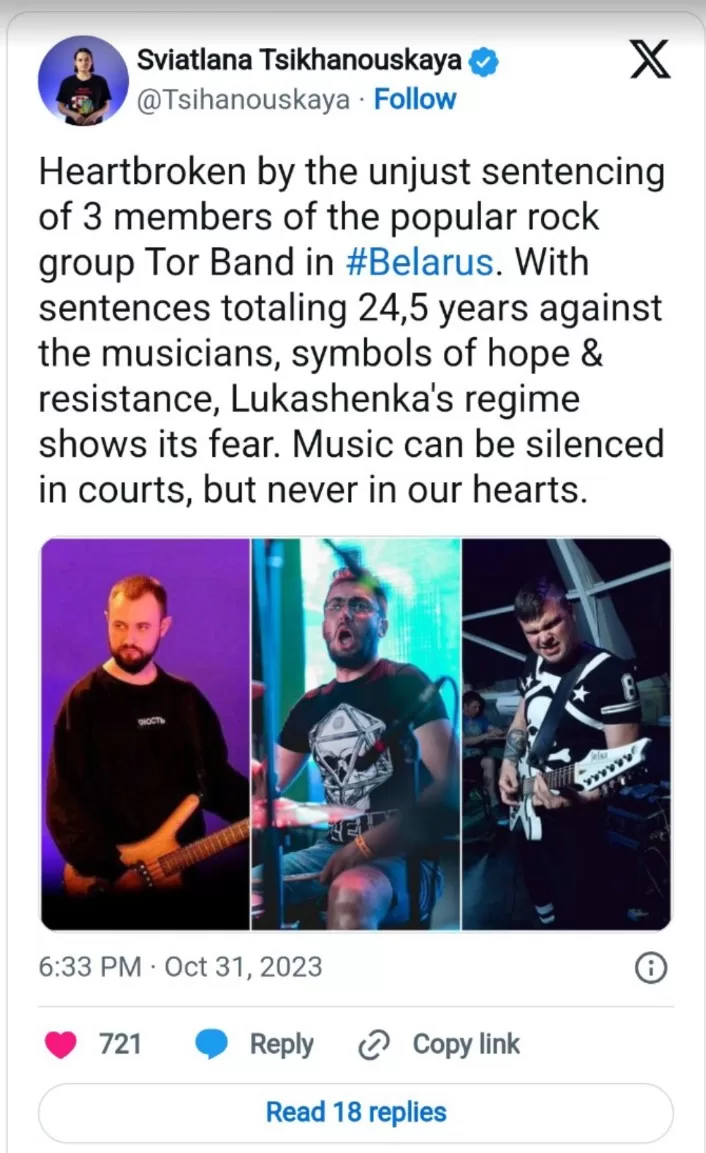
Sviatlana Tsikhanouskaya vehemently condemned the sentences, portraying the imprisoned musicians as “symbols of hope and resistance” in the face of oppression.