


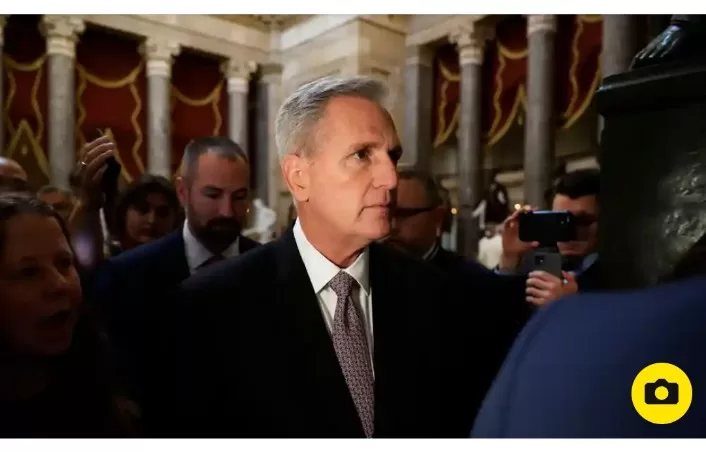
In a stunning twist of political fortune, Kevin McCarthy, who recently led a successful bipartisan effort to avert a government shutdown, found himself removed from his position as the US House speaker on Tuesday. This shocking ousting marks a historic moment in American politics, as it is the first time a House speaker has been removed from office.
McCarthy’s short and tumultuous tenure as the House speaker came to an ignominious end, further undermining the already waning trust in the US political system. The fractious infighting among Republicans has effectively halted all legislative business in the House of Representatives until a new speaker is elected.
McCarthy, acknowledging the inevitability of his removal, declared that he would not seek the speakership again. This decision paves the way for the selection of a new Republican speaker, provided party members can reach a consensus.
A vote to elect a new speaker is scheduled for next Wednesday after a closed-door meeting on October 10 to deliberate on potential candidates, as reported by Reuters.
The move to oust McCarthy was initiated by Florida Republican Congressman Matt Gaetz, who set in motion a motion to vacate the chair. Despite McCarthy’s Republican allies’ attempts to block the motion, a final vote was conducted. In a dramatic turn of events, eight hard-right Republicans joined forces with 208 Democrats to support McCarthy’s removal, overpowering the 210 Republicans who sought to retain him. McCarthy fell short of the simple majority needed to keep his position.
“The resolution is adopted,” announced Congressman Steve Womack, who presided over the session. “The office of speaker of the House of the United States House of Representatives is hereby declared vacant.”
Following this declaration, McCarthy appointed Congressman Patrick McHenry, a North Carolina Republican, as the acting speaker until a new House leader is chosen. McHenry promptly called for a recess to allow both House Republicans and Democrats to regroup and chart their respective courses.
Former Vice President and current presidential candidate Mike Pence expressed concerns that McCarthy’s removal would harm the GOP’s standing with voters. He emphasized that chaos is not a virtue and called for unity within the party.
Former House Speaker Newt Gingrich criticized Gaetz, calling him “anti-Republican” and “actively destructive to the conservative movement.” Some Republican lawmakers are contemplating whether Gaetz should face expulsion from the Republican conference, though their individual stances on the matter remain uncertain.
The eight Republicans who sided with Democrats in the vote cited various reasons for their decision. South Carolina Congresswoman Nancy Mace criticized McCarthy for not adhering to his commitments on how the House should operate. She argued that the situation in Congress would worsen under McCarthy’s leadership.
Tennessee Congressman Tim Burchett revealed that a phone call with McCarthy, where he felt belittled and that his belief system was undermined, influenced his stance. He expressed openness to support various “honorable men” as McCarthy’s replacement.
In a press statement confirming his decision not to run for speaker again, McCarthy stated, “I leave the speakership with a sense of pride and accomplishment. And yes, optimism.” He quoted Teddy Roosevelt’s words about those who “fail while daring greatly.”
McCarthy dismissed the eight Republicans who voted against him, characterizing them as having “small visions.” He asserted that they were individuals not seeking productivity and remarked on his role in their election.
The ousting of McCarthy came about due to a “personal” vendetta against him by Gaetz, stemming from an ongoing Congressional ethics inquiry into Gaetz’s behavior, including allegations of sexual misconduct, illicit drug use, and misuse of campaign funds, as per McCarthy’s comments. McCarthy highlighted Gaetz’s attention-seeking motives and fundraising efforts amid the controversy.
McCarthy shifted blame for the Republican discord primarily to the Democrats, labeling Tuesday’s events as a “political decision” orchestrated by them.
President Joe Biden urged swift action to elect a new speaker, emphasizing the pressing challenges facing the nation that cannot wait.
McCarthy’s removal marks a turbulent nine months in the House, characterized by clashes with the hard-right faction of his party. Despite his attempts at appeasement, his collaboration with Democrats to prevent economic turmoil sealed his fate. With the House’s razor-thin majority, Republicans now face the daunting task of selecting a leader capable of uniting a deeply divided conference.
Gaetz instigated McCarthy’s ousting following the speaker’s cooperation with House Democrats to pass a stopgap spending bill. McCarthy was also accused of striking a “secret side deal” with Joe Biden regarding additional funding for Ukraine, a matter of controversy on the right. McCarthy vehemently denied the existence of such a secret agreement.
The passage of the stopgap bill by both the House and the US Senate with bipartisan majorities averted a potential government shutdown that could have left countless federal workers without pay for an extended period.
Leading up to the vote to oust McCarthy, some Republican House members publicly condemned Gaetz, referring to him as a “chaos agent” and expressing concerns that his maneuver could cost Republicans their House majority.
Tuesday’s vote marked the first removal of a House speaker in over a century and the first successful such vote in American history. While previous House speakers, including former Republican leader John Boehner, faced threats of a motion to vacate, none had to undergo a full-fledged removal effort.
McCarthy’s tenuous hold on the gavel was evident from his arduous path to securing the House speakership in January, requiring 15 rounds of voting. His tenure was marred by a perceived failure to secure adequate concessions from Democrats during negotiations, leaving many Republicans dissatisfied.
House Democratic leader Hakeem Jeffries indicated that his caucus would not assist McCarthy in retaining his position. Ultimately, every present House Democrat voted in favor of McCarthy’s removal.
With McCarthy’s removal, all legislative work in the House remains suspended until a new leader is elected.