

China and Russia have taken more assertive positions regarding the Gaza conflict, deepening geopolitical tensions as the war between Israel and Hamas exacerbates existing divisions between traditional Cold War allies and western powers, notably the United States, the United Kingdom, and France.
Over the weekend, China’s foreign minister made a strong statement, expressing concern that Israel’s bombing campaign exceeded the boundaries of self-defense and called for an end to collective punishment of the people of Gaza.
Russian President Vladimir Putin added fuel to the fire on Friday by likening a potential intensified siege of Gaza by Israel to the infamous Leningrad siege during World War II, a remark likely to provoke deep offense in Israel.
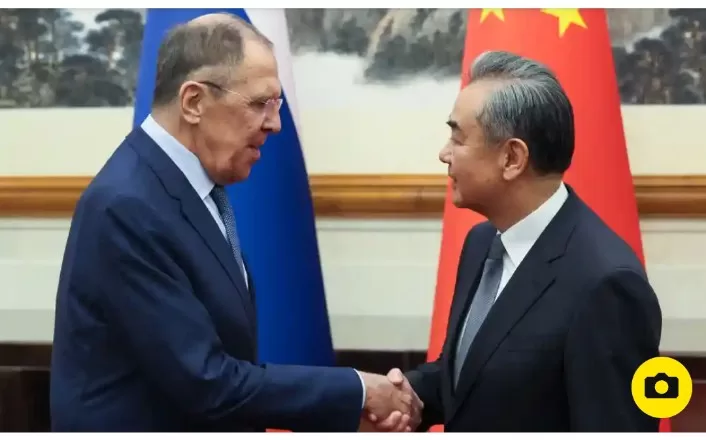
Notably, Russia’s top diplomat, Sergei Lavrov, arrived in Beijing on Monday, anticipating a visit by Putin, raising concerns in the west about their increasingly closer relations.
China has long supported the Palestinian cause, as did the Soviet Union during the Cold War. More recently, both nations have aimed to balance their growing ties with Israel while expanding diplomatic relationships in the Arab world and beyond.
Russia seeks support for its ongoing war in Ukraine, while China aims to build a broader coalition of developing nations to enhance Beijing’s global influence and compete with the United States on the world stage.
Dr. Yu Jie, a senior research fellow on China at the Chatham House think tank in London, noted, “Beijing has been pro-Palestinian since Mao’s days and is mindful about the US’s close ties with Israel… almost anything that the US supports, China must be against. Beijing also wishes to be seen as a key supporter of the global south, which includes most Arab countries retaining friendly ties with China. It’s a matter of maintaining those relations by continuing to support the Palestinians.”
China is seeking to offset concerns in the Islamic and Arab worlds regarding its treatment of Uyghur Muslims in Xinjiang.
The Middle East is crucial to China, providing a substantial portion of its oil and playing a central role in President Xi Jinping’s ambitious Belt and Road Initiative.
Since the war’s inception, Chinese state media has been critical of Israel, placing blame on the US, Israel’s staunchest supporter, for escalating tensions in the region. This has also coincided with an increase in antisemitic content on the tightly monitored Chinese internet, according to Yaqiu Wang, research director for China, Hong Kong, and Taiwan at the US-based Freedom House.
President Putin noted on Friday that Israel had experienced “an attack unprecedented in its cruelty” by Hamas militants and had the right to defend itself, but he also criticized Israel for employing cruel methods in response, highlighting the potential for unacceptable civilian casualties in the event of an Israeli ground offensive.
Russian officials have asserted that Moscow can mediate in the conflict due to its relationships with Israel, the Palestinians, Hamas, Hezbollah, Iran, and significant Arab powers. They have also laid blame on the US, with the Russian ambassador to the UN, Vassily Nebenzia, stating that the US bears “responsibility for the looming war in the Middle East.”
Other major developing powers are facing challenging diplomatic dilemmas. India, which has long focused on the global fight against terrorism, has developed economic and other ties with Israel but has also built new relationships with prominent actors in the Arab world, such as the United Arab Emirates and Saudi Arabia.
Reactions in Africa have been diverse, with the African Union issuing a carefully balanced statement. South Africa, however, has voiced sharp criticism, given its historical and troubled relationship with Israel.
As tensions rise and geopolitical strains intensify, the Gaza conflict continues to fuel divisions on the world stage, requiring diplomatic finesse from various nations.