


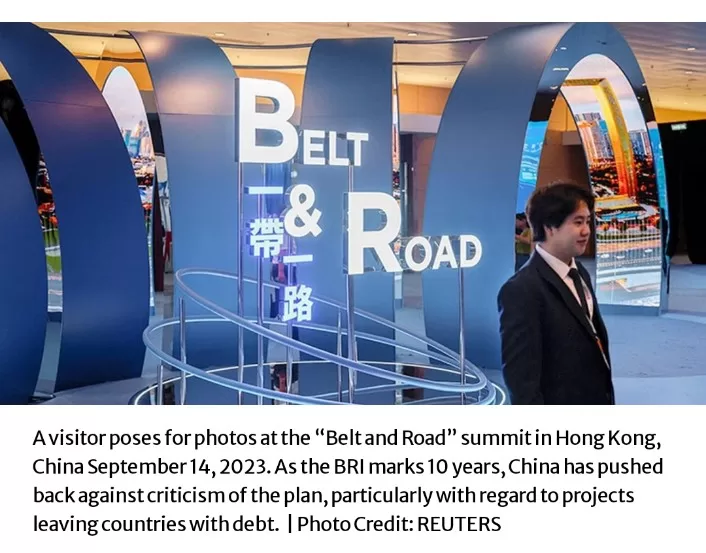
After ten years of substantial projects that amplified international trade but also resulted in considerable financial liabilities and environmental concerns, China’s ambitious Belt and Road Initiative (BRI) is undergoing a profound transformation. This transition is coinciding with the arrival of leaders from numerous developing nations in Beijing for a government-organized conference focused on the BRI.
The BRI, known as “One Belt, One Road” in Chinese, initially commenced as an initiative enabling Chinese enterprises to construct overseas infrastructure, including transportation and energy projects, funded through loans from Chinese development banks. The overarching objective was to enhance global trade and economic growth by establishing modern trade routes reminiscent of the historical Silk Road that connected China with the Middle East and Europe.
President Xi Jinping first introduced this concept during visits to Kazakhstan and Indonesia in 2013, which subsequently led to the realization of major undertakings ranging from railways in Kenya and Laos to power plants in Pakistan and Indonesia.
In terms of scale, 152 countries have entered into BRI agreements with China, although Italy, the sole Western European nation to do so, is expected to exit upon the expiration of its agreement in March next year. Italy’s trade deficit with China has more than doubled since joining the initiative in 2019.
China has become a significant financier of development initiatives under the BRI, rivaling institutions such as the World Bank. The Chinese government reports that over 3,000 projects with a combined worth of nearly USD 1 trillion have been initiated in BRI participant countries.
As other lending institutions have shifted their focus to sectors like healthcare and education, distancing themselves from infrastructure projects due to environmental and community impact concerns, China filled the void by providing substantial development loans. Nevertheless, Chinese-funded projects have encountered similar criticisms, including displacement of local populations and contributing to greenhouse gas emissions.
The issue of debt has also loomed large, as some governments found themselves unable to repay Chinese development bank loans, leading to allegations of “debt trap” diplomacy, where China was accused of intentionally making loans that were likely to default, ultimately giving Chinese entities control over assets. Notable examples include a Sri Lankan port leased to a Chinese company for 99 years.
Although many economists argue that these bad loans were not made intentionally, China has learned from past defaults. In recent years, Chinese development loans have plummeted as banks exercise greater caution in lending, while recipient countries, burdened with high existing debt levels, are less capable of borrowing.
These developments are expected to influence future BRI projects, which are likely to be more environmentally friendly, smaller in scale, and will increasingly rely on investments by Chinese corporations rather than government loans to host nations. Christoph Nedopil, the Director of the Asia Institute at Griffith University in Australia, anticipates that China will continue to undertake significant projects, particularly those with high visibility such as railways, as well as oil and gas pipelines that promise revenue streams for repayment.
Furthermore, China has pledged to cease constructing coal power plants overseas while encouraging initiatives related to the transition to green technologies. This encompasses ventures ranging from wind and solar farms to electric vehicle battery factories, such as the notable CATL plant that has raised environmental concerns in BRI partner Hungary.

