

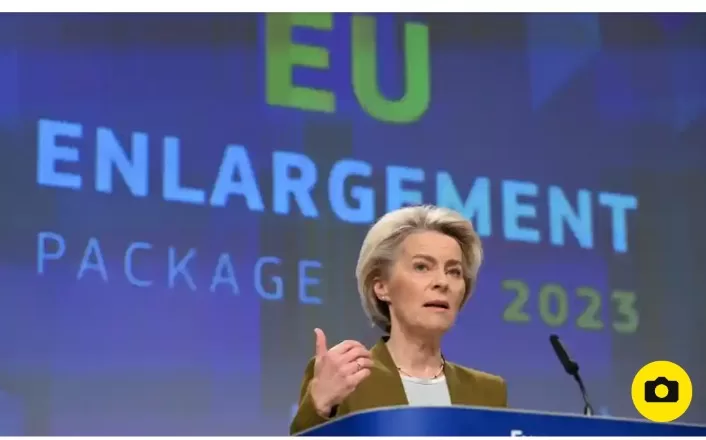
In a momentous policy shift, the European Commission has advocated for the initiation of substantive EU membership dialogues with Ukraine and Moldova, as articulated by the Commission’s chair, Ursula von der Leyen. Characterized as a historical imperative, the commencement of talks is contingent upon the fulfillment of specific prerequisites, notably the intensification of anti-corruption measures, the institution of EU-standard lobbying regulations, and the fortification of protections for national minorities.
In a comprehensive 1,200-page analysis concerning the prospective enlargement of the 27-nation consortium, the Commission has posited that negotiations be activated subsequent to the successful implementation of these reforms. Additionally, the Commission has proposed the commencement of accession discussions with Bosnia, conditional upon similar reforms, and endorsed Georgia’s elevation to candidate status, charting a course for its eventual inclusion in the EU.
The Commission’s resolution, pending ratification by EU prime ministers in an upcoming summit, could herald the most expansive augmentation of the bloc since 2004’s ten-nation accession. This proposal has been met with approbation from Ukraine’s President Volodymyr Zelenskiy, who interpreted it as a pivotal stride towards European integration and a strategic coup for the West amidst Ukraine’s ongoing conflict with Russia.
Von der Leyen has extolled EU membership as a catalyst for economic enhancement and regional stability. Emphasizing the aspirational direction of neighboring nations, she highlighted the unequivocal pro-EU stance of the western Balkans, Georgia, Moldova, and Ukraine.
The European Commission has also proposed the establishment of a €6 billion “accession fund,” intended to incentivize reformative efforts in aspirant nations, with disbursements biannually contingent upon continued progress.
Ukraine’s directives include the completion of anti-corruption legislation and asset declaration system improvements for public officials. Moldova, deemed the “frontrunner” due to its expeditious reform efforts, is tasked with staffing anti-corruption offices and reforming public payment regulations.
This report underscores the European Commission’s commitment to the region’s democratic transformation and strategic alignment with the EU’s values and standards, setting a robust framework for the next phase of European enlargement.