


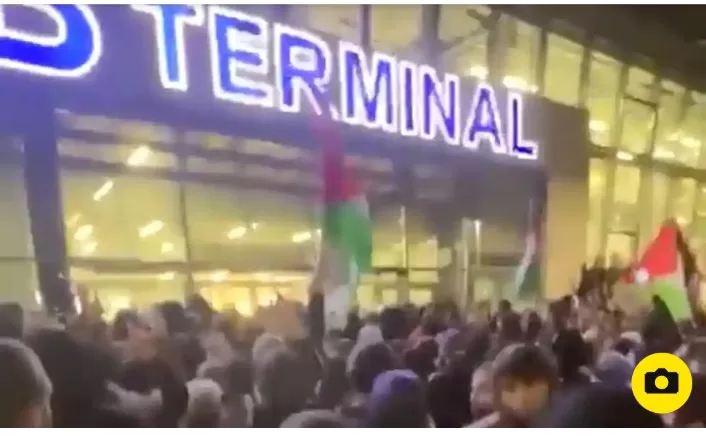
In a shocking turn of events, a tumultuous situation unfolded in Makhachkala airport, situated in Russia’s predominantly Muslim region of Dagestan. A mob descended upon the airport, seemingly in pursuit of Jewish passengers arriving from Israel.
Over the past day, local residents laid siege to a hotel, driven by their quest to identify and confront Jewish guests. Simultaneously, the airport was stormed following reports of a Tel Aviv-bound flight’s imminent arrival in the city. Passengers found themselves compelled to seek refuge within aircraft or shelter within the airport, gripped by the fear of impending attacks. Local health authorities disclosed that 20 individuals sustained injuries, with two in critical condition, although details remained scant.
Videos shared on social media documented hundreds of young men, some brandishing Palestinian flags or placards condemning Israel, breaching the confines of Makhachkala International Airport. They clambered onto stationary planes, even attempting to breach the aircraft’s windows.
In the midst of the escalating chaos, airline employees were observed hustling passengers back into planes as the agitated crowd encroached on the aircraft. Consequently, Russia opted to close Makhachkala airport on Sunday evening, citing “intruders” on the premises.
A public address announcement resonated through the tense atmosphere: “This is your captain. An agitated mob outside remains oblivious to our origins and purpose here. It’s conceivable that we might become the target of aggression.”
The catalyst for these riots appeared to be a series of posts on the Telegram social media platform, wherein followers were alerted to the arrival of a flight from Tel Aviv that evening, carrying refugees from Israel.
Some of the placards brandished by the rioters bore the message, “We are against Jewish refugees.” Remarkably, local law enforcement seemed to be passive observers as hundreds of protesters infiltrated the airport’s principal terminal, trespassing into restricted zones and insisting that customs officials guide them toward the incoming passengers.
Utro Dagestan, one of the Telegram accounts known for disseminating news intermingled with conspiracy theories, implored its followers to lay siege to the local airport, interrogate incoming Israelis, and demand their condemnation of the Israeli government. The account further exhorted locals to shadow arriving Israelis, photograph their vehicles, and record their lodgings.
Additionally, video footage from the airport depicted individuals accosting airline passengers, including those who appeared to have just disembarked from the Tel Aviv flight, some of whom claimed to be local residents who had journeyed abroad seeking medical assistance.
Sergei Melikov, the head of Dagestan, attributed the unrest to external influences, asserting that the upheaval transpired “due to disinformation propagated by our adversaries.”
Late on Sunday, Russia’s aviation authority declared that all “unauthorized individuals” had been expelled from the airport. Concurrently, online video clips seemed to portray law enforcement apprehending certain protesters.
In response to the alarming situation, local religious authorities have indicated that they may need to evacuate approximately 800 Jewish families from various areas in Dagestan, particularly in the southern city of Derbent.
“The situation in Dagestan is exceedingly precarious. Community members are gripped by fear, reaching out for guidance, and I find myself at a loss,” lamented Ovadya Isakov, a government representative of the local Jewish community, in an interview with the Podyom news outlet. “Is it advisable to consider relocation? For Russia may not be our refuge, and history has witnessed pogroms on Russian soil. It’s an uncertain predicament.”
Notably, several prominent figures in Dagestan have expressed solidarity with Palestine and voiced opposition to the Israeli state since October 7, when a Hamas incursion plunged southern Israel into turmoil, resulting in the tragic loss of over 1,400 lives. In retaliation, the Israeli government unleashed an extensive bombing campaign in Gaza, causing an estimated 8,000 casualties as of last Sunday, according to local authorities.
Khabib Nurmagomedov, a former mixed-martial arts champion and an eminent figure in Dagestan, took to Instagram earlier this month, addressing a following of more than 35 million, to declare Israel’s actions as “genocide” in Gaza.
Notably, instances of anti-Jewish actions extended beyond Makhachkala. In Nalchik, another city located in the neighboring Kabardino-Balkaria region, a planned Jewish center was subjected to arson earlier on that fateful Sunday. In a concurrent occurrence, demonstrators laid siege to a hotel in the Dagestani city of Khasavyurt, systematically searching rooms for “Jewish refugees.”
Rabbi Pinchas Goldschmidt, a former chief rabbi of Moscow who departed in 2022 following Russia’s full-scale invasion of Ukraine, took to Twitter to convey reports of “mobs demanding to harm Jews” from four distinct cities within Dagestan. He attributed this disturbing situation to the Russian government’s alignment with Hamas during the conflict and the notable absence of condemnation for the events on October 7.
Meanwhile, a high-profile delegation from Hamas, their first international journey since the October 7 attacks, arrived in Moscow for discussions with the Russian foreign ministry.
Reacting to the tumultuous airport incident, Israel issued a statement, urging Russian authorities to safeguard Israelis and Jews within their jurisdiction.
“The state of Israel views with utmost seriousness any endeavors that endanger Israeli citizens and Jews worldwide,” declared the foreign ministry in Jerusalem. “Israel anticipates the Russian law enforcement agencies to ensure the safety of all Israeli citizens and Jews.”