


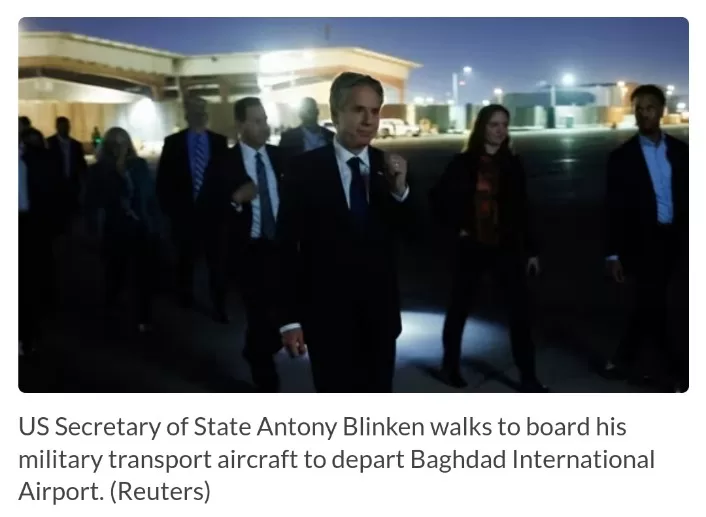
Antony Blinken, the esteemed U.S. Secretary of State, made an unexpected visit to the tumultuous region, affirming the pivotal role of the Palestinian Authority (PA) in shaping the destiny of the Gaza Strip. Blinken navigated through Israeli checkpoints, establishing a historic rendezvous with Palestinian Authority President Mahmoud Abbas in the heart of the West Bank’s Ramallah city before embarking on his journey to Iraq.
In light of the escalating tensions stemming from Israel’s recent conflict with Hamas, Blinken’s visit bore paramount significance. The distinguished diplomat, during a press interaction in Baghdad, asserted the imperative of accommodating Palestinian perspectives, voices, and aspirations at the heart of discussions pertaining to Gaza’s future.
Even as Israel continues its relentless campaign of aerial bombardments, resulting in the lamentable loss of 9,770 Palestinian lives, Secretary Blinken politely dismissed entreaties for an immediate ceasefire. He had previously sought to persuade Israel to engage in measured pauses in the conflict, albeit with limited success. Blinken acknowledged that this was a complex process, with Israel harboring legitimate concerns regarding the logistics and mechanics of any humanitarian interruptions in the conflict. However, it was underlined that any pause should address various pressing issues, including the release of hostages.
While conferring with the Iraqi government, Blinken unequivocally conveyed the unacceptability of threats arising from factions aligned with Iran. He reaffirmed the United States’ commitment to safeguard its personnel and assets in the region, cautioning against the exploitation of the Gaza conflict to imperil regional security.
In the aftermath of the conflict, Blinken is laboring to instigate dialogues about Gaza’s future governance after the prospective dismantling of Hamas, as envisioned by Israel. President Abbas underscored the significance of Gaza within the broader Palestinian state framework. It was suggested that any participation of the Palestinian Authority in Gaza’s governance must be part of a comprehensive resolution of the age-old conflict that encompasses the entirety of the West Bank, East Jerusalem, and Gaza Strip.
It was emphasized that the United States should play the role of a neutral mediator rather than endorsing any single narrative, as articulated by Husam Zomlot, head of the Palestinian Mission to the United Kingdom.
While Blinken presented promising ideas for the future, the urgent priority remains halting the loss of civilian lives.
Blinken has proposed the formation of an “effective and rejuvenated Palestinian Authority” to oversee Gaza. However, it is also acknowledged that international organizations and foreign nations may be involved in governing and maintaining security in the interim. The fate of President Abbas’s government, which holds partial autonomy in the Israeli-occupied West Bank but has seen dwindling support, remains uncertain.
The foreign ministers of Egypt and Jordan had urged an immediate ceasefire to address the humanitarian crisis that has besieged Gaza. While Blinken argued that an unconditional ceasefire might provide respite for Hamas, he is striving to persuade Israel to consider location-specific pauses that would enable essential aid to reach Gaza.
It is a challenging landscape, where Hamas exercises tight control over beleaguered Gaza, while the West Bank is a complex tapestry of hillside cities, Israeli settlements, and military checkpoints. The post-conflict period has witnessed heightened violence, with more than 170 incidents involving Jewish settlers targeting Palestinians.
Blinken commended President Abbas for his efforts to maintain calm in the West Bank, and he communicated his calls for accountability to Israeli officials.
Stay tuned for further developments as the international community grapples with the complex dynamics in this region.
By Reuters