

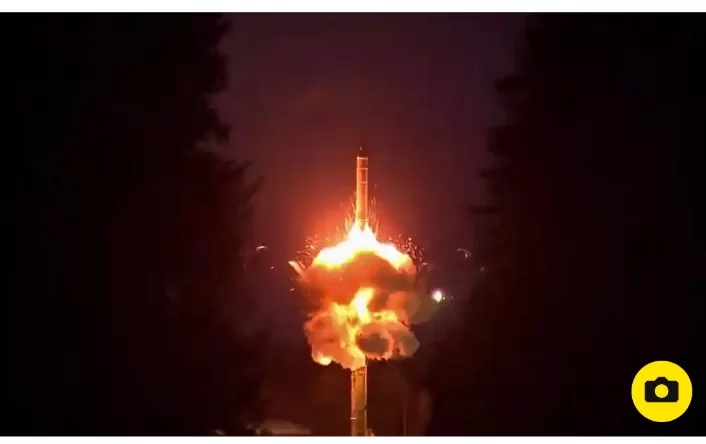
In a recent military exercise, a Yars intercontinental ballistic missile was launched from the Plesetsk cosmodrome in the northern reaches of Russia. This exercise, which occurred on the heels of the upper house of parliament’s decision to rescind Russia’s ratification of the Comprehensive Nuclear Test Ban Treaty, was overseen by President Vladimir Putin.
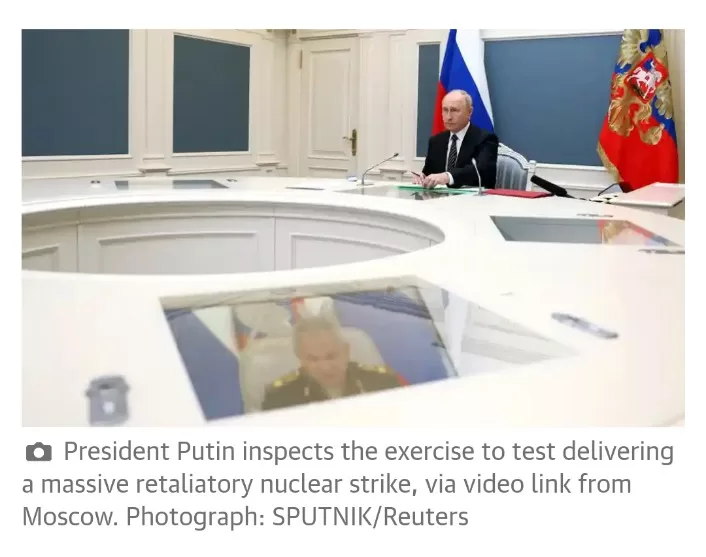
The bill, initially approved in the lower house the week prior, now awaits Putin’s final approval. He has explicitly stated that Russia’s decision to revoke its 2000 ratification aligns with the stance of the United States, which signed but did not ratify the same treaty. This development took place with President Putin directing the exercise via video call in the company of top military officials, as shown on state television.
The stated purpose of this exercise, according to Russia’s minister of defense, Sergei Shoigu, is to prepare for the eventuality of executing a “massive nuclear strike with strategic offensive forces in response to a nuclear strike by the enemy.” While similar drills are conducted each autumn, Shoigu’s comments held particular significance amidst the escalating tensions between Russia and Western nations, driven by the ongoing conflict in Ukraine.
The Comprehensive Nuclear Test Ban Treaty, established in 1996, effectively prohibits all nuclear explosions worldwide, but its full implementation has remained elusive. Notably, several countries, including China, India, Pakistan, North Korea, Israel, Iran, and Egypt, have yet to ratify the treaty.
Concerns loom large that Russia might consider resuming nuclear tests as a deterrent, aiming to dissuade Western countries from offering military support to Ukraine. This sentiment finds resonance among certain Russian hawks who advocate for a resumption of nuclear testing. Putin, however, has emphasized that he has not yet formed a definitive opinion on this matter, acknowledging the debate within the expert community.
Sergei Ryabkov, Russia’s deputy foreign minister, previously stated that Moscow remains committed to respecting the test ban and will only contemplate resuming nuclear tests if the United States takes such action first. Ryabkov disclosed that the Russian foreign ministry received US proposals for resuming a dialogue on matters of strategic stability and arms control. Still, he made it clear that Moscow deems this infeasible in the prevailing political climate, citing the need for a significant change in the US’s policy towards Russia.