


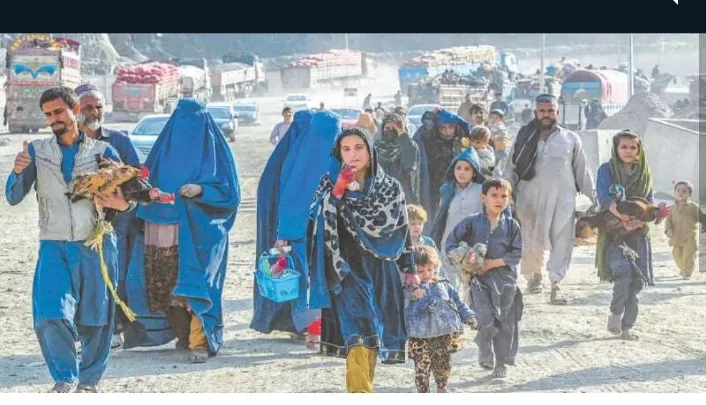
In a recent development, the Office of the United Nations High Commissioner for Human Rights (OHCHR) has issued a resounding call to the Pakistani government. OHCHR, concerned about the rights and welfare of Afghan nationals residing in Pakistan, urges the government to halt all forcible deportations immediately. The OHCHR spokesperson, Ravina Shamdasani, voiced her concerns from Geneva, emphasizing the need to prevent what could become a severe human rights crisis.
Shamdasani stated, “We call on them to continue providing protection to those in need and ensure that any future returns are safe, dignified, and voluntary, fully aligning with international legal standards.” The OHCHR believes that those facing deportation could potentially be exposed to grave human rights violations upon their return to Afghanistan, including arbitrary arrests, detention, torture, and inhumane treatment.
The situation is indeed alarming, as Pakistan has declared its intention to deport “undocumented” foreign nationals residing in the country after November 1. This measure, if enforced, will disproportionately impact over 1.4 million undocumented Afghan individuals still living in Pakistan. Among these individuals, certain groups face particularly heightened risks, including civil society activists, journalists, human rights defenders, former government officials, security force members, and, notably, women and girls. In Afghanistan, existing policies have severely restricted their access to education, employment, and participation in many facets of daily life.
The United Nations refugee agency, UNHCR, and the International Organization for Migration (IOM) have already noted a sharp increase in the number of Afghans returning to Afghanistan since the deportation deadline was announced on October 3. Recent data from UNHCR and IOM reveals that 59,780 individuals left Pakistan in the month leading up to October 15, with 78% citing fear of arrest as the primary reason for their departure.
Notably, the OHCHR emphasizes that deportations without individualized assessments of personal circumstances, including any mass deportations, would constitute refoulement. This is in direct violation of international human rights law, particularly the Convention Against Torture and Other Cruel, Inhuman, or Degrading Treatment or Punishment, to which Pakistan is a signatory, and international refugee law.
As winter approaches, the consequences of mass deportations are likely to compound the dire humanitarian crisis in Afghanistan. The country is grappling with the aftermath of a series of devastating earthquakes that struck Herat province this month, leaving at least 1,400 people dead and 1,800 injured, according to official figures. The United Nations Office for the Coordination of Humanitarian Affairs reports that nearly 30 million people in Afghanistan require relief assistance, out of a total population of 43 million, with 3.3 million internally displaced.
In conclusion, the OHCHR strongly reminds the de facto authorities in Afghanistan of their continued international human rights obligations and underscores their duty to protect, promote, and fulfill human rights in the nation.