


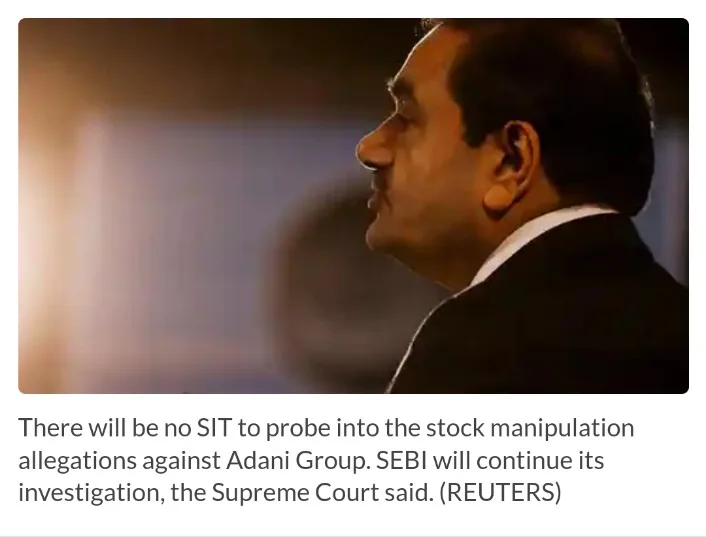
New Delhi, In a pivotal decision, the Supreme Court has opted not to intervene in the Securities and Exchange Board of India (SEBI) investigation into the Adani Group, thereby dismissing the plea for a Special Investigation Team (SIT) probe. The court asserted that there were no grounds to question SEBI’s diligence in its ongoing inquiry.
A three-judge bench led by Chief Justice DY Chandrachud declared that the apex court’s jurisdiction within SEBI’s regulatory framework is limited. The court further clarified that reports such as Hindenburg’s cannot serve as the basis for ordering a separate investigation. Instead, SEBI has been directed to continue and conclude its inquiry within the next three months.
This verdict brings relief to the Adani Group, which faced allegations of fraudulent transactions and share-price manipulation presented by Hindenburg Research. The court rejected the reliance on third-party reports without proper verification, emphasizing the necessity for conclusive evidence.
Having already completed investigations in 20 out of 22 matters, SEBI is now tasked with finalizing the remaining two within the stipulated three-month timeframe. The report of the Office of the Chief Corporate Relations (OCCPR) was deemed insufficient to cast doubt on SEBI’s investigation.
The SEBI-Adani-Hindenburg case reached the Supreme Court through multiple petitions, including those filed by lawyers Vishal Tiwari, ML Sharma, and Congress leaders Jaya Thakur and Anamika Jaiswal. These petitioners alleged that SEBI’s investigation acted as a shield for the Adani Group, protecting it from regulatory violations and market manipulations.
During the case, Solicitor General Tushar Mehta, representing SEBI, pointed out the emerging trend of planting stories outside India to influence domestic affairs and policies.