


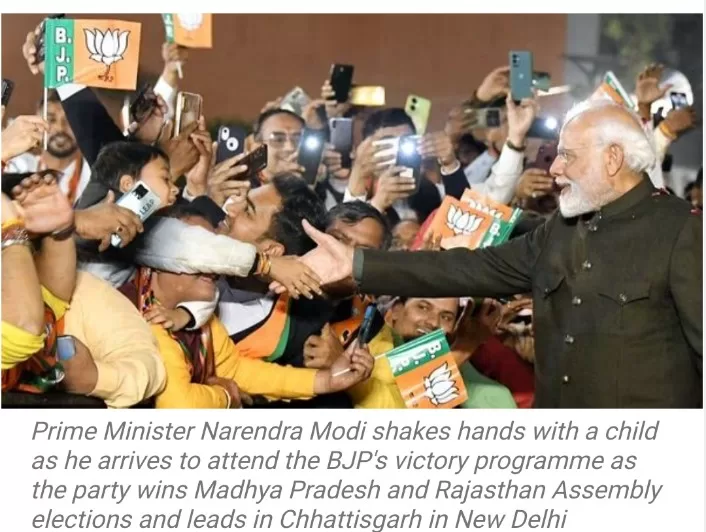
In a day marked by significant setbacks for the Congress party, the results of the Rajasthan Assembly elections unfolded as the Bharatiya Janata Party (BJP) secured victory in the state. While the BJP won 115 seats compared to Congress’s 69, a closer examination of the vote share reveals a narrow margin between the two major parties.
The Congress, despite the overall loss, garnered 39.5% of the votes, only 2.2% less than the BJP’s 41.7%. This indicates that, on a broader scale, there was not a significant shift in electoral support for the Congress compared to the BJP.
Despite the narrative of anti-incumbency, the Congress managed to secure runner-up positions in an impressive 111 seats, contrasting with the BJP’s 66. The defeat for the Congress is more a story of margins, with the BJP clinching victory in seats where the margin exceeded 20,000 votes. Out of 77 such seats, the BJP won 45, leaving the Congress with 28.
In seats with victory margins between 10,000 and 20,000 votes, the BJP continued to dominate, securing 34 out of 55, while the Congress managed only 19. The margin trend continued in seats with less than 10,000 votes, where the BJP outpaced the Congress.
Chief Minister Ashok Gehlot secured victory in Sardarpura with a margin of 26,396 votes, maintaining a substantial lead over the BJP’s Mahendra Rathore. Meanwhile, former Chief Minister Vasundhara Raje won Jhalrapatan with an impressive margin of 53,193 votes.
However, the big ones for the BJP included notable victories in seats like Kotputli, where Hansraj Patel won by 321 votes, and Vidhyadhar Nagar, where the BJP secured a whopping 71,368-vote margin. The BJP’s dominance in key constituencies contributed significantly to its overall success.
NOTA Impact:
Curiously, in 17 seats, the “None of the Above” (NOTA) option garnered more votes than the victory margin, signaling voter dissatisfaction.
Outlook:
As Rajasthan Chief Minister Ashok Gehlot tendered his resignation following the BJP’s landslide victory, the state’s political landscape faces significant shifts. The Congress, despite facing defeats, can find solace in the fact that the vote share remained relatively close, hinting at potential opportunities for future political maneuvers.