


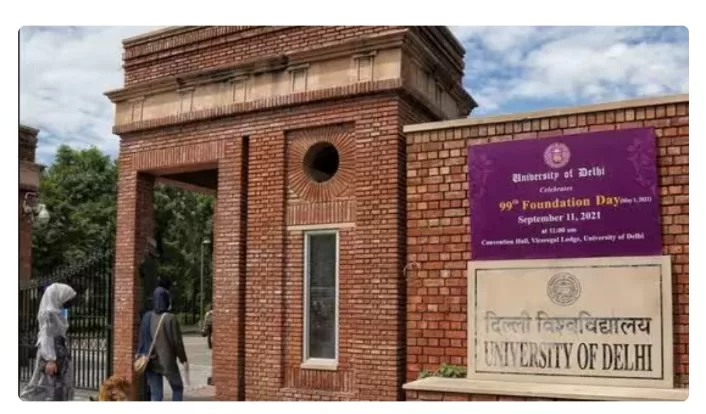
In a noteworthy decision, the Delhi University’s academic council (AC) has given the nod to a proposal for dual degrees, allowing students to engage in two academic programs concurrently. However, the final approval from the university’s executive council is still pending, with the date yet to be announced.
Under the dual-degree proposal, students are permitted to pursue two degrees simultaneously, on the condition that one of the courses is through distance learning or in the online mode. Notably, students will not be allowed to choose two similar courses, ensuring distinct academic pursuits.
In addition to the dual-degree approval, the AC unanimously passed new regulations for the promotion of teachers in DU departments and centers. Teacher advancements will now be linked to publications in journals approved by the University Grants Commission (UGC).
Two significant items on the agenda were deferred for consideration in the next meeting. These include the “twinning degree,” allowing students to study one semester in a foreign higher education institute, and providing up to 20% of university courses through the online Swayam portal.
While some members of the AC view the dual-degree proposal as a beneficial opportunity for students, others express concerns. Alok Ranjan Pandey from Ramanujan College sees it as a potential advantage in the current job market, but Biswajit Mohanty from Deshbandhu College argues that pursuing two degrees may compromise the true purpose of education.
Abha Dev Habib from Miranda House emphasized, “A degree without proper education holds no value at all.”
Teacher promotions will now be based on the publication of at least 10 research papers in the Scopus Journal or in journals included in the UGC CARE list. The initial proposal of 15 published papers was revised to 10 after opposition from AC members, who also removed peer review as a condition for promotion.
The AC introduced an aptitude enhancement course called “Hindi EL” in the first or second semester for students who have not studied Hindi until Class 8. Additionally, the syllabus of three Delhi School of Economics papers was approved by the academic council.