


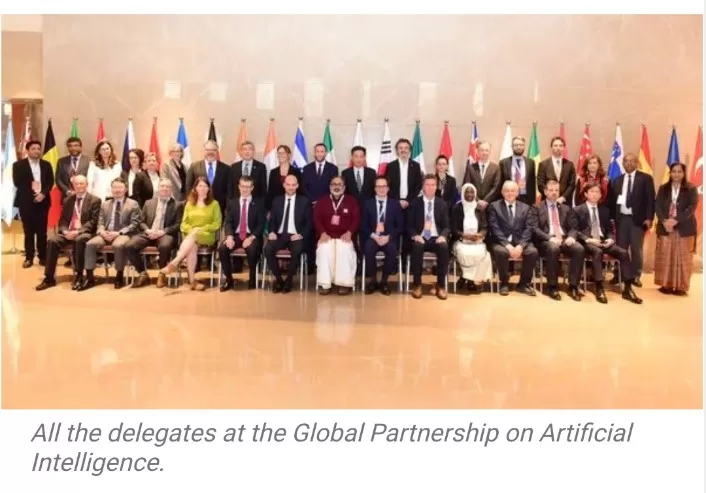
New Delhi, The Global Partnership on Artificial Intelligence (GPAI) Summit, comprising 29 member nations, including the European Union, declared the adoption of the New Delhi Declaration. Led by Union Minister Rajeev Chandrasekhar, the declaration commits to collaborative development of AI applications in healthcare and agriculture. It emphasizes the inclusion of Global South needs in AI development.
The participating nations also agreed to utilize GPAI as a platform for establishing a global framework on AI trust and safety. India proposed hosting a GPAI Global Governance Summit within six months to finalize this framework.
Chandrasekhar stated, “29 countries of the GPAI have unanimously adopted the New Delhi Declaration, positioning GPAI at the forefront of shaping the future of AI innovation and collaboration.”
The 14-point declaration, a copy of which was obtained by Mint, underscores the focus on inclusive AI development, with an emphasis on benefiting countries in the Global South.
Notable attendees included Jean-Noel Barrot, Minister of Digital Affairs for France; Hiroshi Yoshida, Vice-Minister of Internal Affairs for Japan; and Viscount Jonathan Camrose, Minister of AI and Intellectual Property for the UK.
Barrot commended Japan’s establishment of an ‘expert support center’ for AI, expressing intentions to collaborate with OECD resources during India’s GPAI presidency.
The summit concluded with the announcement that India would unveil its official AI policy under the India AI Program on January 10, addressing concerns of innovation, ethics, and regulation. Global discussions on AI regulations are set to continue at the Korea Safety Summit in mid-2024.
In an earlier interview, Chandrasekhar emphasized the importance of a global legal framework for regulating AI, drawing parallels with past global regulatory agreements on technologies with potential for mass harm.
Prime Minister Narendra Modi, on Tuesday, emphasized that the development of AI globally should adhere to humanitarian and democratic values, urging an all-inclusive approach.