

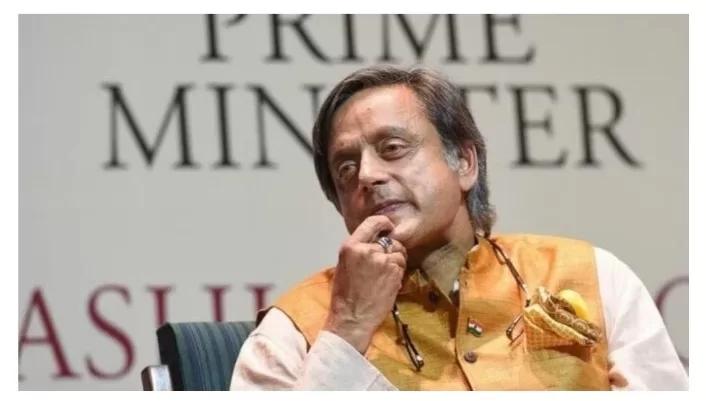
In a recent development, Congress Member of Parliament, Shashi Tharoor, has offered a clarifying statement regarding his comments made at a private gathering. Tharoor addressed his previous remarks, wherein he characterized his party as “family-run” and discussed the prospects of Rahul Gandhi ascending to the position of Prime Minister. His clarifications shed light on the intricacies of the Indian political landscape.
Tharoor underscored that his initial comments, made in an informal setting and not tailored for public consumption, were susceptible to misinterpretation. He emphasized his unwavering belief in the integral role played by the Nehru/Gandhi family within the Congress party, asserting that this family’s legacy serves as a bedrock of strength for the organization.
In response to a query posed during the inauguration of a technology company’s new office in Thiruvananthapuram, Tharoor delineated the fundamental distinctions between the electoral processes of India and the United States. He elucidated that, unlike the U.S. system where primary elections determine presidential candidates, in India, political parties decide on their Prime Ministerial nominee as well as constituency representatives.
Tharoor expounded upon the pivotal importance of securing a majority of at least 272 Members of Parliament to form a government, highlighting the vastness and complexity of India’s political landscape, where 543 parliamentary seats are at stake.
Moreover, he expressed optimism regarding the potential for unexpected outcomes in the forthcoming election, particularly due to the formation of a collaborative Opposition bloc consisting of several political parties. Tharoor ventured to predict that, within the Congress party, either Mr. Kharge or Rahul Gandhi could emerge as strong contenders. He alluded to the family-centric nature of the party, opining that, in many ways, it operates as a family-run institution. He underscored the merit of India’s parliamentary system, where the Prime Minister is regarded as the “first among equals,” sharing responsibilities with other ministers. He exuded confidence in his ability to fulfill any responsibilities entrusted to him effectively.
In sum, Tharoor’s clarifications offer a nuanced perspective on the dynamics of Indian politics, highlighting the interplay between political parties, leadership selection, and the multifaceted challenges of governance in the world’s largest democracy.