

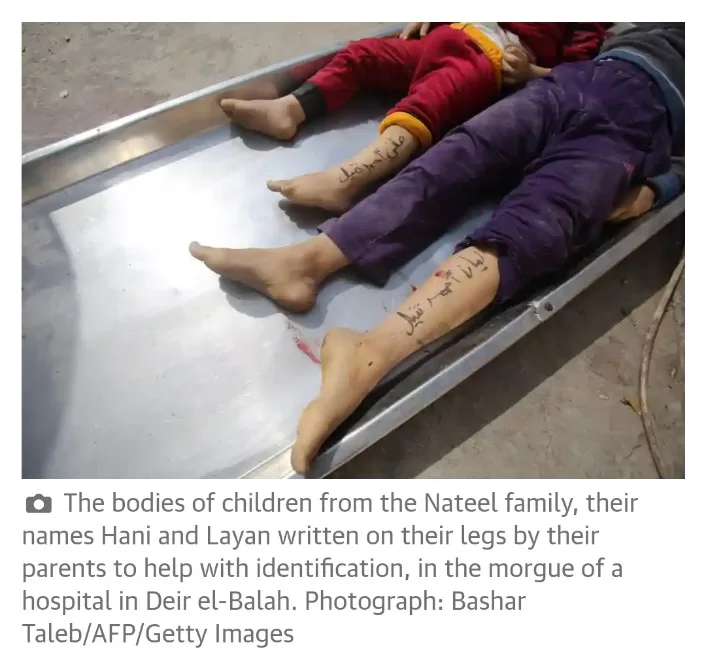
“In the beleaguered enclave of Gaza, a constant dread of sudden demise has led mothers to inscribe their children’s names upon their limbs as a grim precaution, should they fall victim to an airstrike amidst the unrelenting Israeli offensive.
Unfolding before the eyes of the world is a conflict seemingly at odds with the 21st century, as Israeli military operations unfold from the advanced machinery of jets and the control hubs of state-of-the-art naval vessels. However, on the ground in southern Gaza, the unfolding reality has regressed existence to bygone decades.
The barrage escalated dramatically during Friday night, delivering the most punishing aerial assaults thus far in this ongoing war. The heavens glowed with fiery intensity as mobile networks, internet access, and even satellite communication were severed, isolating Gaza from global communication.
Even prior to this escalation, families displaced from Gaza City and its northern counterparts, subjected to the harshest of Israeli bombardments, found their survival in the haphazard collection of discarded furniture and scavenged wood from the streets, serving as their sole fuel source for cooking. The scarcity of cooking gas compounded their plight. With power and internet unavailable, the populace has largely relinquished phones and televisions, reinforcing an atmosphere of bleak isolation. For those fortunate enough to possess them, radios have emerged as the sole gateway to the external world.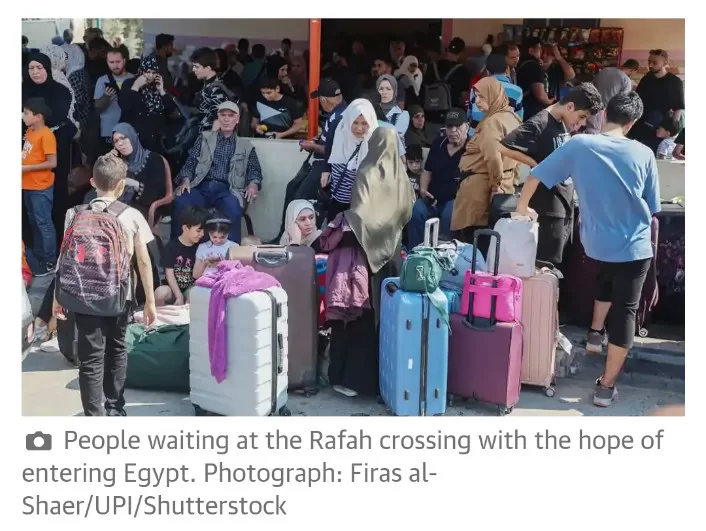
Refrigeration systems lie dormant, heightening the perpetual threat of food and waterborne ailments. Those who manage to secure refuge in the homes of friends and family have overcrowded these havens. UN-administered schools, traditionally employed as sanctuaries during times of conflict, have been inundated, with over 600,000 individuals converging upon 150 schools.
Additionally, internally displaced individuals have congregated in open areas adjacent to hospitals, under the impression of greater safety, while some families resort to sleeping in their vehicles.
The backdrop to these daily tribulations is the ceaseless Israeli bombardment, with scores of strikes every hour—a relentless barrage that commenced following the audacious incursion of militant Islamist group, Hamas, which resulted in the tragic loss of 1,400 lives, predominantly civilians, through a surprise attack earlier in the month.
This grim setting has introduced a disconcerting practice of inscribing children’s names on their lifeless forms. This phenomenon, affirmed by photographs of deceased children within a Gaza morgue, is corroborated by the testimony of physicians and grieving parents.
Gaza’s prevailing circumstances, both in life and death, are rendered profoundly formidable. An example is Amr, 47, who, with his wife and two children, departed Gaza City two weeks prior.
Amr shares his plight, “I have a Kia Sorento car. We’re in Khan Younis now staying near a UNRWA [United Nations Relief and Works Agency for Palestine Refugees in the Near East] school. We can’t sleep in the school, so we have to sleep in the car. Sometimes I’ll drive to find a place to find toilets or we’ll go to friends’ or relatives’ homes to shower every few days. It’s not a life.”
“We’ve been waiting for Rafah crossing [into Egypt] to reopen so we can travel. I tried to go many times, but without success.”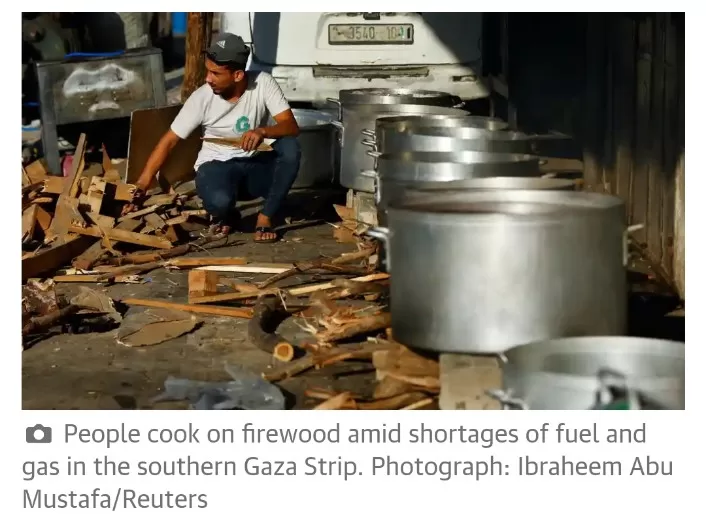
Given the scarcity of humanitarian access and with almost half of Gaza’s 2.3 million residents displaced over the past three weeks, Amr’s account stands as a somber archetype.
The UNRWA recently cautioned that in the absence of fuel reaching Gaza, their operations would face cessation. This declaration contradicts the Israeli military’s assertion that fuel reserves in the territory remain adequate.
“If fuel is not received into Gaza, UNRWA will be forced to significantly reduce and in some cases bring its humanitarian operations across the Gaza Strip to a halt. The coming 24 hours are very critical,” the agency stated.
The distressing scarcity of fuel, a consequence of Israel’s declared ‘complete siege,’ has resulted in a dearth of electricity, restricting the ability of ordinary Gazans to maintain external communication.
Unfortunate queues form for the basic necessity of water, as the lack of electricity leaves water pumps incapacitated. Queues can be agonizingly lengthy, often extending up to five hours at local bakeries. Talal Ayman, a 19-year-old student, voices his frustrations, “I’ve been waiting here for almost two hours,” he said. “I have at least another hour queueing until I reach the bakery entrance. I spend almost every day doing this to get bread. It’s so harsh. I’ve seen fights over people trying to jump the queue. I don’t know when this is going to end.”
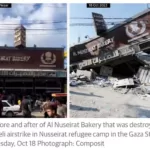
Notably, despite the Israel Defense Forces’ directive to relocate to the “safer” south, places like Nuseirat do not conform to conventional safety standards. Just this week, the family of Al Jazeera’s Arabic bureau chief, Wael Dahdouh, perished in an airstrike on Nuseirat. Reports suggest even the market itself has come under fire.
Wafa Bash, a 56-year-old mother of seven, reflects on the hardships of daily existence in the Nuseirat marketplace, “I come here every day to see what’s available in the vegetable market to see if I can find something to cook for the family. We can’t store things in the house because there’s no power to the fridge. So I have to come here daily.”
The scarcities impose grueling queues under open skies, exemplified at the local bakery in Nuseirat where patrons often stand for hours. Mohammed Abed, a 61-year-old resident, summarizes the trying situation, “There’s no cooking gas available now. People have very few options to make bread or cook at home. I have relatives in my house, who fled from different places in Gaza city. It’s difficult to manage and feed so many mouths.”
Amidst the challenges, Amr broadens the scope of responsibility, “I don’t blame one party for this. They are all responsible and blind to what is happening: Hamas, Israel, the Arab countries and US and EU countries.”
The dark realities continue to plague Gaza, as the world watches on with a sense of helplessness and sorrow, yearning for a resolution to the relentless turmoil.”