

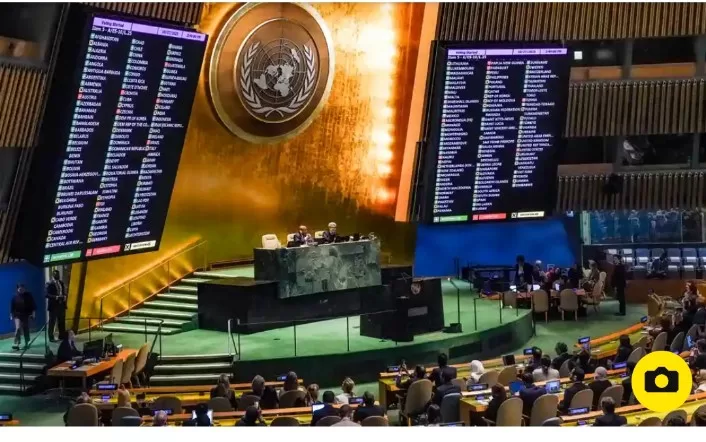
In a resounding move, the United Nations General Assembly has resolutely called for an “immediate, durable, and sustainable humanitarian truce” between Israel and Hamas, underlining the urgency of unhindered aid access to the embattled Gaza Strip.
Although the resolution, masterminded by Jordan, is not legally binding, it holds significant political and symbolic weight, signifying a widening international isolation of the United States and Israel as Israel escalates its ground operations.
The resolution secured a landslide victory with 120 votes in favor, while 45 member states chose to abstain, and 14, including Israel and the US, voted in opposition.
The resolution refrained from explicitly naming Hamas, which is currently detaining approximately 220 civilian hostages seized during the catastrophic attacks on October 7. Nevertheless, it staunchly demands the “immediate and unconditional release” of all unlawfully held civilians, emphasizing their safety and humane treatment. The resolution unequivocally condemns attacks on both Palestinian and Israeli civilians.
Furthermore, the resolution insists on the unimpeded delivery of essential supplies to the Gaza Strip and continuous access for humanitarian workers. It calls upon Israel to revoke its directive for Gaza residents to relocate from the north to the south and firmly rejects any endeavors to forcibly transfer the Palestinian civilian population.
In a crucial move, the resolution underscores the imperative need to “urgently establish a mechanism to ensure the protection of the Palestinian civilian population.”
Riyad Mansour, the Palestinian envoy to the UN, conveyed a message of urgency: “It sends the message to everyone, enough is enough. This war has to stop, the carnage against our people has to stop, and humanitarian assistance should begin to enter the Gaza Strip.”
Despite attempts by the US and Canada to name and condemn Hamas directly, along with a call for the immediate release of hostages, this proposal fell short of achieving the required two-thirds majority, registering 88 votes in favor and 55 against.
Originally, Jordan had called for an immediate ceasefire, but in an effort to gain broader support, the resolution was amended to advocate for an immediate, durable, and sustainable humanitarian truce leading to a cessation of hostilities.
This marks the first instance in which the UN has articulated a collective stance on the Middle East crisis. Earlier efforts to establish a unified position within the smaller 15-member UN Security Council had faltered due to the exercise of vetoes by either Russia or the US.
Israel’s ambassador, Gilad Erdan, expressed vehement opposition to the vote, asserting that any ceasefire would merely provide Hamas with the time to rearm, potentially leading to further violence.
Hamas, on the other hand, welcomed the call for a pause in hostilities, emphasizing the necessity of immediate application to facilitate the entry of fuel and humanitarian aid for civilians.
Linda Thomas-Greenfield, the US envoy, decried the resolution as “outrageous” and claimed it provided cover for Hamas, describing the organization’s goals as “single-minded and sickening.”
While the General Assembly’s resolution is not legally binding, it represents a potent message of international concern for the Israel-Gaza conflict and emphasizes the urgency of humanitarian assistance and a lasting ceasefire.