


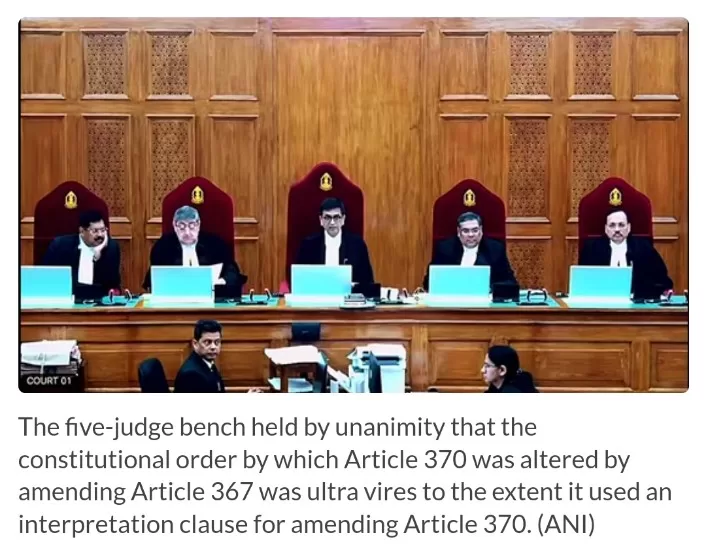
New Delhi, In a significant takeaway from the Supreme Court’s Constitution bench verdict on the abrogation of Article 370, the apex court disapproves of the Centre’s method of amending Article 370 using an interpretation clause in another article of the Constitution. The unanimous decision by the five-judge bench underscores that the constitutional order altering Article 370 via an amendment to Article 367 was ultra vires, as it used an interpretation clause, bypassing the prescribed procedure for amendment under the Constitution.
Chief Justice of India Dhananjaya Y Chandrachud, along with justices Sanjay Kishan Kaul, Sanjiv Khanna, Bhushan R Gavai, and Surya Kant, ruled that while the ‘interpretation’ clause can define terms, it cannot amend a provision by bypassing the specific procedure laid down for its amendment. The judgment emphasizes the need to adhere to established procedures to avoid a circumvention of the amendment process.
The controversy arose when Parliament introduced a new clause under Article 367, stating that the “Constituent Assembly” of Jammu and Kashmir would now mean “Legislative Assembly” under Article 370. This paved the way for Parliament to assume the powers of Jammu and Kashmir’s legislative assembly, ultimately granting approval for the nullification of Article 370 in August 2019.
The bench agreed with petitioners, asserting that Article 367, addressing the interpretation of the Constitution, has inherent limitations and cannot be used for substantial amendments. Amendments, according to the judgment, should follow the prescribed procedures under Article 368 or specific clauses under Article 370 for amending Article 370.
The judgment warned against permitting amendments through circuitous methods, stating that it would be disastrous for the Constitution. Chief Justice Chandrachud’s judgment, supported by Justices Gavai and Kant, stressed that neither the interpretation nor definition clause can be used to substantively alter provisions of the Constitution.
Justice Kaul, in his concurring opinion, argued against using Article 367(4) to amend other provisions of the Constitution, as it could circumvent established procedures and have disastrous consequences. The judgment concludes that modifications like the one attempted in this case cannot make radical alterations that efface the fundamentals of the provision.