

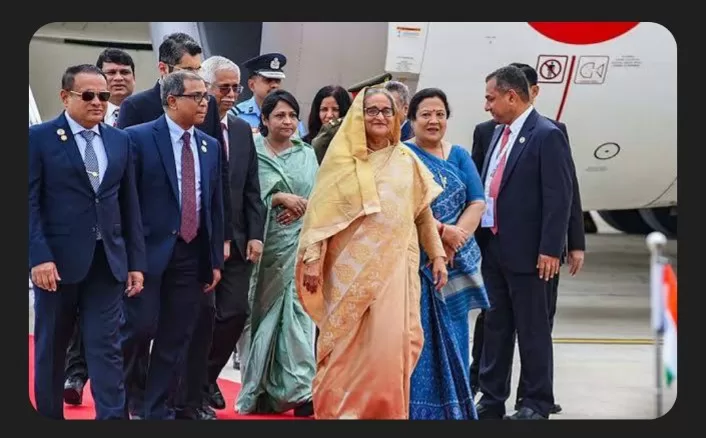
Saima Wazed, the daughter of Bangladesh’s Prime Minister Sheikh Hasina, is accompanying her mother during her visit to India for the G20 summit. This marks Saima Wazed’s second prominent appearance at an international event, following her recent trip with Bangladesh’s President Mohammed Shahabuddin to Indonesia for the ASEAN summit, where her candidacy for a WHO position garnered global attention. Her participation has sparked speculation that she may assume a more significant political role within the ruling Awami League in the future.
During the G20 summit, Sheikh Hasina is scheduled to inaugurate a rail link with Tripura and the second unit of the Rampal power plant, in virtual collaboration with Prime Minister Narendra Modi. This event will be held on the sidelines of the G20 meeting. Additionally, several agreements will be signed, including one facilitating a Rupee-Taka card for citizens of both countries to conduct transactions in local currency while traveling, rather than relying on dollars.
A senior official from the Bangladesh foreign ministry confirmed, “Saima Wazed will be in Delhi during the G20 talks.”
The issue of succession within the Awami League has been under consideration for some time. While it is expected to follow a democratic process, familial ties within the political party cannot be discounted. Ambassador Sarvajit Chakravarti, who has served in Dhaka and is currently associated with the think tank Ceners-K, stated, “We believe that it will be done in a democratic manner, but democracy does not eliminate familial ties that a person may have with a political party.”
This development holds significance as it is possibly the first time Sheikh Hasina’s daughter has accompanied her mother during an official visit to India. Analysts are closely observing whether Saima Wazed will opt for a more substantial role within Bangladesh’s political landscape.
Saima Wazed, an autism expert and candidate for the regional director position for the South-East Asia Region (SEARO) at the World Health Organization (WHO), is seeking India’s endorsement, among other countries in the region.
The decision between Saima Wazed and Nepal’s Shambhu Prasad Acharya for the WHO role presents a challenge for India, which maintains significant ties with both Bangladesh and Nepal.
Shantanu Mukherjee, IPS (Retd), former National Security Advisor to Mauritius and a Bangladesh expert, remarked, “A visit by Sheikh Hasina’s daughter to India at a global meeting is an interesting development. Besides her nomination for an international organization, it bears watching if she will opt for a larger role in Bangladesh.”
Professor Omprakash Mishra, an expert in international relations and former Vice-Chancellor of North Bengal University, emphasized India’s consistent support for its increasingly important neighbor, Bangladesh, in international forums.
Sheikh Hasina has not yet indicated a potential successor within the Awami League. However, her son Sajeeb Ahmed Wazed, popularly known as Joy Wazed, was once considered a potential candidate. Saima Wazed, who has served as an advisor to the WHO director-general on Mental Health and Autism and as a member of the WHO expert advisory panel on Mental Health, has not shown any inclination toward entering politics so far.
Dr. Sreeradha Datta, former director of the Maulana Abul Kalam Azad Institute of Asian Studies and currently a fellow with the National University of Singapore, remarked, “We have not seen Sheikh Hasina suggest any succession plan as yet, though over the years, we have noted that her son Sajeev has been given responsibilities in IT, etc., by the Awami League. Now, Saima Wazed has also come into the picture. One can only presume that both are being groomed for a political role in the future.”
Bangladesh is heading for a general election in the upcoming winter months, with the Awami League aiming to secure its fourth consecutive victory. However, the principal opposition party, BNP, led by former Prime Minister Begum Khaleda Zia, has demanded that Hasina step down and allow a caretaker government to oversee the elections—a demand unlikely to be granted by the Awami League-led government.
While the United States has already announced a policy that reserves the right to deny visas to individuals, including officials and politicians, who hinder free and fair elections in Bangladesh, many other countries appear to be endorsing Hasina’s leadership, considering Bangladesh as a rising economic star in Asia. French President Emanuel Macron is scheduled to visit Bangladesh right after the G20 summit in Delhi, and Russian Foreign Minister Sergei Lavrov visited Dhaka ahead of the summit.
PTI