

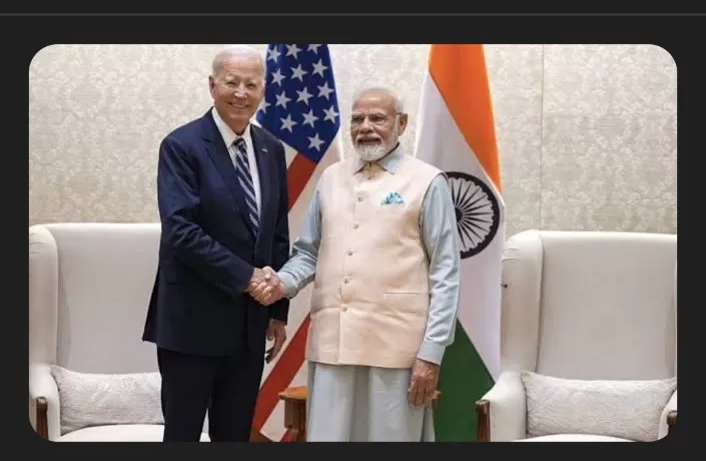
United States President Joe Biden touched down in Delhi ahead of the G20 Summit, where Prime Minister Narendra Modi hosted him for a significant bilateral discussion at his residence. The Prime Minister’s Office released photographs of the two leaders engaged in talks that are set to deepen the India-US relationship.
The agenda for their discussions encompasses a range of crucial subjects, including a potential deal for jet engines, the procurement of predator drones, and collaboration on advanced technologies such as 5G and 6G networks.
While there have been speculations about a major rail deal, US National Security Advisor Jake Sullivan refrained from confirming these reports. Nevertheless, he highlighted the significance of enhancing connectivity from India through the Middle East to Europe, emphasizing the substantial economic and strategic benefits it could offer to all participating nations.
Following their bilateral meeting, Prime Minister Modi hosted President Biden for a dinner engagement.
Earlier today, President Biden expressed his optimism for the G20 Summit, emphasizing its role as a premier forum for international economic cooperation. He underscored its focus on addressing American priorities, supporting developing nations, and demonstrating the G20’s capacity to deliver meaningful outcomes.
President Biden is accommodated at the prestigious ITC Maurya Sheraton in the capital city.
While the White House aims to demonstrate the United States’ ability to contribute to global progress at this summit, it is taking place against a backdrop of emerging economies uniting in groups like BRICS to ensure their concerns receive due attention.
Last month, the BRICS bloc, comprising Brazil, Russia, India, China, and South Africa, extended its membership to include six additional nations, including the United Arab Emirates and Saudi Arabia.
President Biden, who had recently tested negative for COVID-19, embarked on this journey after a medical scare when First Lady Jill Biden tested positive for the virus.
As for the possibility of a joint statement following the G20 Summit, US National Security Advisor Jake Sullivan indicated that its realization depended on the willingness of all countries to cooperate and engage constructively. Key challenges include addressing the Ukraine conflict and climate change, with some oil-producing nations advocating for less ambitious climate goals. Additionally, China’s efforts to link technology access to the wording of any declaration have presented another hurdle.
A galaxy of global leaders, including the Prime Ministers of Australia and the United Kingdom, arrived in Delhi for the summit. UK Prime Minister Rishi Sunak, upon his arrival, reaffirmed his government’s commitment to combat Khalistani terror threats, emphasizing the unacceptability of extremism or violence in the UK.