

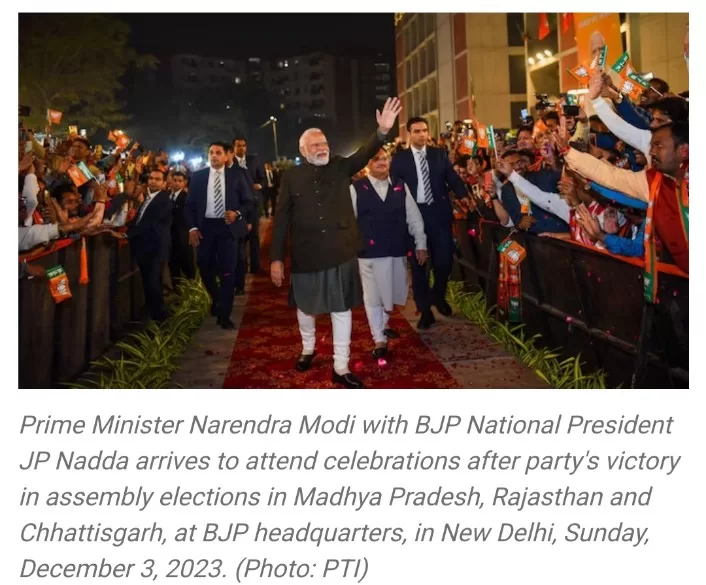
New Delhi: Following the BJP’s decisive triumph in the recent assembly elections in Rajasthan, Chhattisgarh, and Madhya Pradesh, the party now governs a significant portion of India, totaling 12 states out of 28. In contrast, the Congress is left with just three states – Telangana, Karnataka, and Himachal Pradesh.
The BJP’s political influence has grown substantially, with the party also participating in a ruling coalition in four states – Maharashtra, Nagaland, Sikkim, and Meghalaya.
Data compiled from 2014 to December 3, 2023, reveals the BJP’s remarkable expansion, covering 58% of India’s land area and 57% of the population. Meanwhile, Congress-governed states constitute 41% of the country’s land area, with 43% of the population.
PM Modi, addressing the recent victories, stated that the BJP’s “hat-trick” in state elections is a precursor to a similar feat in the 2024 Lok Sabha polls. He attributed the success to the endorsement of his agenda focusing on a self-reliant India, good governance, and transparency.
With this victory, the BJP now holds nearly half of the 543 Lok Sabha seats. The Aam Aadmi Party (AAP), led by Delhi Chief Minister Arvind Kejriwal, has emerged as the third-largest national party.
The BJP’s political evolution over the years has seen it secure a presence in the North East, ruling four states independently and participating in a coalition in Meghalaya, Nagaland, and Sikkim. The recent state wins set the stage for the 2024 General Elections.
PM Modi, reflecting on the assembly elections, emphasized a focus on unity and identified four key elements – women empowerment, youth empowerment, farmers, and poor families.
The Congress, despite winning in Telangana, faces setbacks. The four states where the BJP triumphed have a collective voter base of over 160 million and account for 82 seats in the 543-member parliament.
BJP President Jagat Prakash Nadda credited the victory to the party’s political strategy and ground-level work. The political landscape has shifted significantly since the BJP first came to power in 2014, with the party ruling Rajasthan, Gujarat, Madhya Pradesh, Goa, and Chhattisgarh initially.
As of December 2017, BJP-ruled or coalition states covered 78% of the land area and 69% of India’s population. In the same period, Congress-governed states constituted only 22% of the land area, with 31% of the population.
The BJP’s presence in the North East, practically non-existent in 2014, has grown to include ruling four states and being part of a coalition government. The recent victories highlight the BJP’s strong position heading into the 2024 Lok Sabha polls.
While the BJP celebrates its expanding political footprint, the Congress faces internal conflicts, notably in Rajasthan. The newly formed INDIA bloc, comprising Congress and other regional opposition parties, aims to challenge the BJP’s dominance in 2024.