


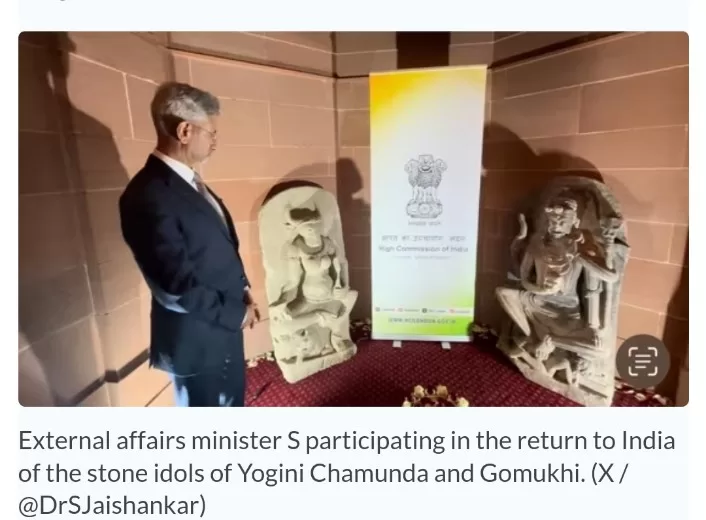
In a distinguished event in London, External Affairs Minister S Jaishankar led a repatriation ceremony for two precious 8th-century temple idols, Yogini Chamunda and Yogini Gomukhi, pilfered from a temple in Lokhari, Uttar Pradesh, between the late 1970s and early 1980s and subsequently discovered in England.
Recovered through collaborative efforts of the High Commission of India in London, the India Pride Project, and Art Recovery International, the idols were unveiled by Jaishankar at India House on the culmination of his five-day visit to the UK. Expressing anticipation for their return to India, Jaishankar stressed the importance of legal, transparent, and rules-based cultural exchanges in today’s context.
The term ‘Yogini’ denotes female masters of yogic arts, with 64 divine Yoginis worshipped as goddesses at Yogini temples like Lokhari. The Lokhari temple, believed to house 20 Yogini statues, was targeted by robbers in the 1970s, operating from Rajasthan and Maharashtra, smuggling goods into Europe via Switzerland.
Acknowledging the sensitivity of cultural heritage, Jaishankar emphasized the significance of correcting deviations in cultural exchanges, sending a potent message against unacceptable practices. The repatriation event marks the fifth successful return of vital cultural pieces to India, highlighting collaborative efforts with organizations like the India Pride Project and Art Recovery International.
Chris Marinello of Art Recovery International highlighted the organization’s collaborative approach, working closely with the India Pride Project to identify and negotiate the return of stolen artifacts. Indian High Commissioner to the UK, Vikram Doraiswami, underscored the objective of finding amicable solutions for the return of heritage to its rightful place.
In a broader context, Jaishankar’s diplomatic efforts extend beyond cultural restitution, encapsulating India’s commitment to transparent and rule-abiding international engagements. As the geopolitical landscape evolves, the minister’s initiatives contribute to fostering mutual respect and appreciation of diverse cultural legacies.
By PTI