


Jerusalem- An unsettling incident unfolded at the prestigious Israel Museum in Jerusalem on Thursday night as an American tourist was apprehended for the intentional destruction of two second-century Roman statues, raising profound questions about the security of irreplaceable cultural treasures and the surge in attacks against heritage sites in the city.
Local law enforcement authorities have identified the alleged perpetrator as a radical 40-year-old Jewish American visitor. Preliminary investigations suggest that his motivation for this act of vandalism was driven by religious convictions, deeming the statues as “idolatrous and contrary to the Torah.”
In a surprising twist, the defendant’s attorney, Nick Kaufman, has refuted claims of religious fanaticism, asserting that his client suffers from a psychiatric disorder known as the “Jerusalem syndrome.” This condition, characterized by a profound sense of disorientation induced by the religious magnetism of Jerusalem, often leads individuals to believe they are figures from biblical narratives.
In response to these developments, the accused has been ordered to undergo a comprehensive psychiatric evaluation. Authorities, respecting a gag order, have refrained from disclosing his identity.
The incident transpired against a backdrop of heightened religious fervor and simmering tensions during the Jewish holiday season. Reports of confrontations, including spitting incidents and assaults, involving radical ultra-Orthodox Jews targeting Christian worshippers have been on the rise, instilling unease among tourists, evoking indignation within the local Christian community, and drawing widespread condemnation. The Jewish holiday of Sukkot, marking the conclusion of the harvest festival, concludes this Friday at sundown.
The Israel Museum, renowned for its exhibits encompassing archaeology, fine arts, and Jewish art and cultural artifacts, has characterized Thursday’s vandalism as a “disturbing and exceptional occurrence.” The institution unequivocally condemned all forms of violence and expressed hope that such regrettable incidents will not recur.
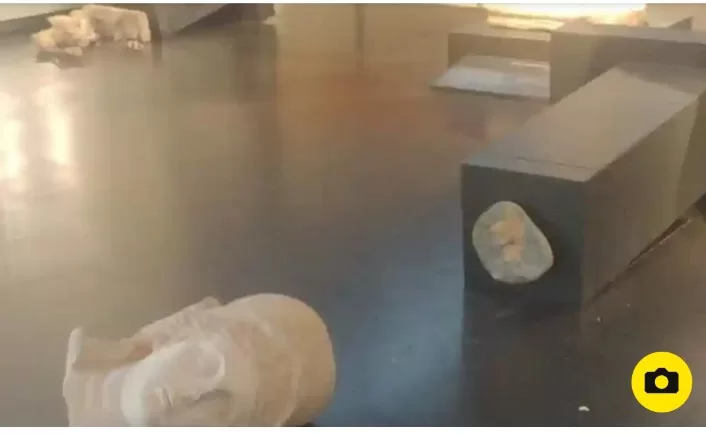
Photographs from the scene reveal the marbled head of the goddess Athena toppled from its pedestal onto the floor and the fragmentation of a statue portraying a pagan deity. Museum personnel are currently engaged in the painstaking task of restoring these damaged relics. The museum has not disclosed the precise value of the statues or the extent of the damage incurred.
The Israeli government has reacted with alarm to this defacement, attributing it to a form of Jewish iconoclasm rooted in the historical prohibition against idolatry. Eli Escusido, director of the Israel Antiquities Authority, decried the act as a “shocking case of the destruction of cultural values,” emphasizing the disconcerting trend of religiously motivated extremism targeting cultural heritage.
This act of vandalism appears to be the latest in a series of attacks by individuals of the Jewish faith against historical artifacts in Jerusalem. In February, a Jewish American tourist damaged a statue of Jesus at a Christian pilgrimage site in the Old City, while in January, Jewish teenagers defaced historical Christian tombstones at a prominent Jerusalem cemetery.
Despite this disconcerting incident, the Israel Museum resumed its regular public hours approximately 16 hours after the defacement, upholding its commitment to preserving and showcasing cultural heritage.
In conclusion, as a reader-funded news organization, we rely on the support of our global readers to maintain our independence and continue producing quality investigative journalism. Subscribing to our news app empowers us to provide independent reporting and ensures our sustainability for years to come. Your support makes a significant impact in championing open and transparent journalism.