



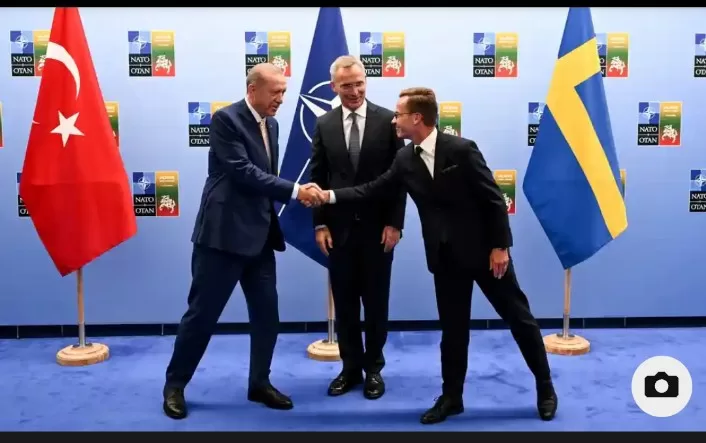
Turkish President, Recep Tayyip Erdoğan, has taken a significant step towards clearing the path for Sweden’s NATO membership by introducing a bill for parliamentary ratification. This move aligns with Erdoğan’s commitment made during the NATO summit held in July, wherein he pledged to present the bill for parliamentary approval once the legislative session resumed in October.
While the bill’s passage through the Turkish parliament is expected to be a mere formality, Erdoğan’s track record includes leveraging Sweden’s NATO application to extract concessions from the United States, notably involving the sale of F-16 fighter jets to Ankara—a deal entangled in the United States Senate.
Notably, Erdoğan has been insistent on Sweden enhancing its handling of the extradition of Kurdish asylum seekers residing in Sweden. Turkish authorities have maintained that Sweden’s measures to combat the banned Kurdistan Workers Party militia remain insufficient.
In a promising development, the Turkish parliament recently progressed the accession bill. The presidential office conveyed, “The protocol on Sweden’s NATO accession was signed by President Recep Tayyip Erdogan on October 23, 2023, and referred to the Grand National Assembly of Turkey,” through the social media platform X (formerly known as Twitter).
Sweden’s NATO membership still awaits approval from only two NATO member countries: Turkey and Hungary. The Hungarian leadership, closely associated with Ankara and having diplomatic ties with Moscow, has displayed mixed signals regarding its stance on Sweden’s accession. At times, Hungary has described the delay as a mere “technical” matter, while on other occasions, it raised objections to what it perceived as unwarranted criticism of Hungarian democracy by Sweden.
However, most observers believe that Hungary might have been using Turkey as a shield, hesitant to be the sole NATO member obstructing Sweden’s path to membership. Officials within NATO have received assurances from Hungary that it does not intend to be the last country to ratify Sweden’s membership, particularly after Turkey’s commitment to the cause.
Sweden’s bid for NATO membership is of paramount significance. It was submitted alongside Finland’s application following Russia’s incursion into Ukraine. While Finland’s NATO membership was confirmed in April, signifying a significant expansion of the alliance, Sweden’s application carries distinct importance.
Additionally, the security concerns faced by Baltic and Scandinavian nations due to Russia’s adversarial actions were underscored when Sweden reported damage to a telecommunications cable in the Baltic Sea, connecting Sweden and Estonia. This incident was found to be related to damage sustained by a pipeline and cable between Estonia and Finland, following the deliberate sabotage of a subsea gas pipeline and telecommunications cable between Finland and Estonia in October.
Sweden’s Prime Minister, Ulf Kristersson, immediately welcomed the recent developments and expressed eagerness for Sweden to become a NATO member. The bill is now slated to appear before the parliament’s foreign affairs commission, which will need to approve it before forwarding it to the general assembly for ratification.
In summary, Turkey’s recent move has further paved the way for Sweden’s NATO membership, marking a critical step in strengthening the alliance amid evolving geopolitical dynamics and security concerns.