



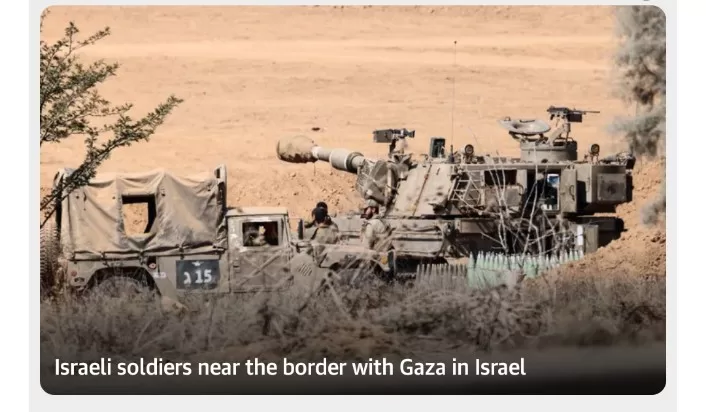
“In a significant nocturnal incursion, Israeli infantry, bolstered by a formidable contingent of tanks and armored bulldozers, executed a protracted ground raid within the northern precincts of the Gaza Strip. This operation unfolded while European Union (EU) leaders were finalizing a comprehensive resolution seeking the establishment of ‘humanitarian corridors and pauses’ to expedite the provision of urgently needed aid into Gaza. The mission saw a convoy of no less than a dozen main battle tanks and assorted armored vehicles traverse an opening in the Gaza border wall, culminating in a concentrated assault upon a nearby enclave of dilapidated structures.
While Israeli troops have recurrently ventured into Gaza during recent hostilities, this particular incursion bears a far more extensive scale, evidently designed to influence the tactical landscape for forthcoming border confrontations. Remarkably, the troops, reportedly from the Givati brigade and 162nd Armoured Division, emerged unscathed from the raid. As articulated by Israeli military spokesperson Rear Admiral Daniel Hagari, ‘Through this operation, we have successfully neutralized threats, eliminated terrorists, dismantled explosive ordnance, and thwarted ambushes, thereby facilitating the groundwork for subsequent stages of this ongoing conflict.’
The conflagration between Israel and Hamas has persisted since the incursion of Hamas militants across the border on October 7th, resulting in a lamentable toll of approximately 1,400 lives, predominantly civilians, and the abduction of numerous individuals. The Hamas-administered health ministry in Gaza has reported a grievous loss of more than 6,500 Palestinian lives, with looming concerns that this toll may escalate further should Israel continue to press forward with ground incursions.
This week bore witness to a heart-wrenching tragedy, as the wife, son, daughter, and grandson of seasoned Al Jazeera journalist Wael al-Dahdouh fell victim to an Israeli airstrike. The Qatar-based network broadcasted poignant footage capturing the journalist’s anguish as he entered a hospital to encountyer his deceased son. Dahdouh and fellow mourners, donned in the blue flak jackets emblematic of reporters in the Palestinian territories, convened for the funerals.
Israel maintains that its military actions exclusively target militant installations, rebuffing allegations that Hamas employs a strategy of mingling among civilians within densely populated Gaza. In retaliation, Palestinian militants have unleashed barrages of rockets into Israeli territory since the conflict’s inception.
With a substantial deployment of troops amassed along the Gaza border, Israeli Prime Minister Benjamin Netanyahu has averred that Israel is ‘raining down hellfire’ and is actively preparing for a consequential ground offensive. Netanyahu, however, has refrained from disclosing specific details, indicating that ‘when, how, how many, and the majority of elements considered in this endeavor remain undisclosed to the public.’
Amid mounting international apprehension over the dire humanitarian conditions in Gaza, the European Council is poised to join the chorus of voices advocating a humanitarian intermission in the hostilities, thereby permitting the unfettered access of aid to 1.4 million displaced Palestinians. The preliminary EU declaration underscores the ‘gravest concern for the deteriorating humanitarian situation in Gaza,’ while pledging to collaborate with regional partners to safeguard civilians and provide essential provisions, including sustenance, medical care, fuel, and shelter, with due vigilance against potential misuse by terrorist organizations.
Since the eruption of hostilities on October 7th, the Israel Defense Forces (IDF) have conducted multiple incursions to investigate Hamas positions and gather intelligence regarding hostages.
In parallel, Israel conducted strikes on approximately 250 locations overnight, including a naval attack upon what was claimed to be ground-to-air missile launchers in the southern Gaza Strip’s Khan Younis.
Reports from Israeli media have surfaced concerning negotiations aimed at securing the release of a substantial number of hostages in the forthcoming days. Citing unnamed Israeli and foreign sources, the left-leaning Haaretz newspaper revealed that advanced discussions are underway, with the prospect of a major hostage release within a short timeframe.
The World Health Organization, in a poignant appeal, called upon Hamas to substantiate the well-being of the hostages in its custody and to expedite their release on humanitarian grounds. The situation is particularly dire for many hostages, including children, women, and the elderly, who require immediate and sustained medical care and treatment, given their pre-existing health conditions. The WHO’s director-general, Tedros Adhanom Ghebreyesus, underscored the acute psychological trauma afflicting the hostages and their families, highlighting the paramount importance of psychosocial support.
Notwithstanding the growing global consternation over the humanitarian impact within Gaza, high-ranking Israeli officials and Hamas, recognized as a proscribed terrorist group in various countries, including the UK, have intimated the potential intensification of the conflict. Saleh al-Arouri, the deputy head of the Hamas political bureau based in Lebanon, contended that ‘the [actual] battles have not yet commenced.’ Simultaneously, Benny Gantz, a member of Israel’s war cabinet and a former IDF chief of staff, indicated that the conflict is poised to transition into more intense phases.
In the United States, reports have emerged suggesting that President Joe Biden has urged Israeli Prime Minister Netanyahu to refrain from launching a ground invasion while Hamas retains hostages. However, on Wednesday, President Biden refuted such claims, asserting that he did not demand the suspension of the invasion but suggested that, if feasible, the hostages be safely extracted.
The incursion transpired against the backdrop of an ominous warning from the United Nations, highlighting the imminent depletion of fuel reserves in the Gaza Strip. This dire situation has necessitated a drastic reduction in relief efforts within a territory under complete siege since Hamas’s violent incursion into southern Israel ignited the ongoing conflict.
The United Nations Relief and Works Agency for Palestinian Refugees (UNRWA) has sounded the alarm over dwindling fuel supplies, raising concerns that the humanitarian crisis may rapidly worsen. Despite Israel permitting the entry of over 60 trucks carrying aid from Egypt in recent days, aid workers contend that this falls far short of the pre-war volume. Crucially, Israel continues to restrict fuel deliveries, ostensibly out of concerns that Hamas might lay claim to them.
An official with the International Committee of the Red Cross expressed hope in delivering eight trucks laden with essential medical supplies, albeit acknowledging that this represents only a fraction of the requisite aid. ‘This is but a modest contribution relative to the overarching need,’ remarked William Schomburg, the head of the sub-delegation in Gaza. ‘Our endeavors center on establishing a sustainable supply route.'”