


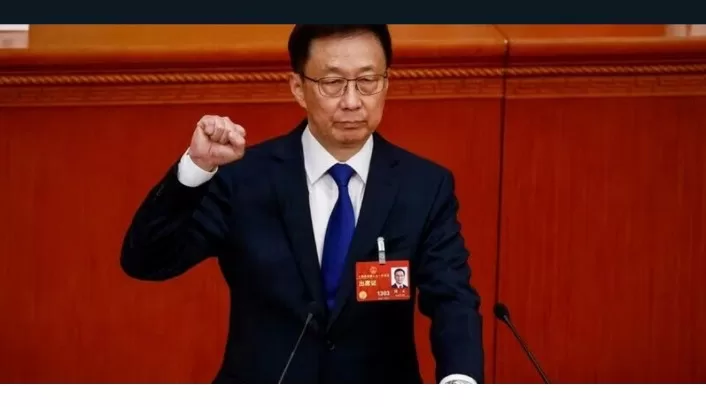
SINGAPORE — In a noteworthy development, Chinese Vice President Han Zheng has declared China’s readiness to engage with the United States at “all levels.” This statement comes on the eve of a highly anticipated summit in San Francisco, where leaders Xi Jinping and Joe Biden are poised to meet in person for only the second time in nearly three years, as they endeavor to mend strained relations.
The upcoming summit, scheduled to take place on the sidelines of the Asia-Pacific Economic Cooperation (APEC) forum, follows an extensive six-month diplomatic effort by the United States to engage its geopolitical rival. This initiative includes several high-level cabinet-level visits, culminating in a bid to recover from a diplomatic crisis triggered by the U.S. downing of an alleged Chinese spy balloon back in February.
During his address at the prestigious Bloomberg New Economy Forum in Singapore, Chinese Vice President Han Zheng underscored the “positive signals” emerging from recent high-level meetings between Beijing and Washington, signaling a potential improvement in bilateral relations.
While relations between the United States and China have endured significant strains in recent years, exacerbated by issues such as export controls, human rights, and national security, both sides now appear determined to reconcile. The Biden administration’s proactive stance has seen top officials engaging with Beijing, with President Biden expressing his anticipation of “constructive” talks with Chinese leader Xi on the sidelines of the San Francisco summit next week.
In response to inquiries about the summit’s confirmation, China’s foreign ministry reiterated that both sides had agreed to the meeting but cautioned against complacency. Ministry spokesperson Wang Wenbin emphasized the necessity of implementing the consensus reached by the two heads of state, addressing obstacles, and enhancing consensus, alluding to a meeting last year between Xi and Biden in Indonesia.
Han Zheng, echoing President Xi’s perspective, emphasized that the trajectory of U.S.-China relations “bears on the future of humanity,” affirming that “the world is big enough for the two countries to develop themselves and prosper together.”
Notably, while U.S. officials have indicated an “agreement in principle” for the Xi-Biden summit in San Francisco, Beijing has not yet confirmed Xi’s attendance at the Asia-Pacific Economic Cooperation (APEC) gathering scheduled for November 15 to 17. APEC, comprising 21-member economies representing approximately 62% of global GDP and nearly half of global trade, has increasingly become a stage for strategic competition between the U.S. and China.
As tensions and expectations rise, Oriana Skylar Mastro, a China expert from Stanford University, anticipates that the impending summit will cast a substantial shadow over APEC proceedings. While the Biden administration maintains that assessing the progress in U.S.-China relations through a slate of meeting outcomes is an outdated measure, experts point to encouraging signs such as the increased number of commercial flights between the two nations.
By Agencies