


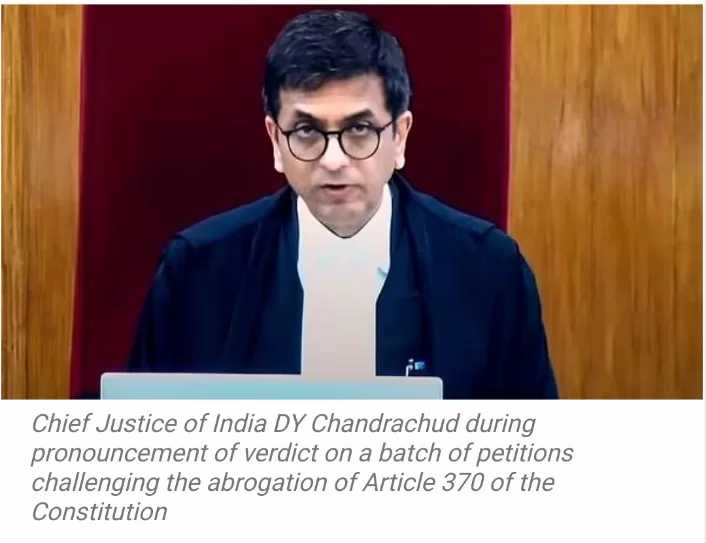
New Delhi, In a recent hearing on the abrogation of Article 370, Chief Justice of India DY Chandrachud emphasized that every decision made by the Union government on behalf of the state is not subject to challenge, stating that challenging every decision could lead to chaos and uncertainty. The Supreme Court upheld the abrogation of Article 370 but directed the restoration of Jammu and Kashmir’s statehood and urged the Election Commission to conduct elections in the region by September 30, 2024.
During the Article 370 hearing, the Supreme Court noted, “Every decision and action taken by the Union executive on behalf of the State is not subject to challenge.” The court highlighted the potential consequences of challenging every decision, stating that it could lead to chaos and disrupt administration.
The unanimous Supreme Court ruling upheld the abrogation of Article 370 while emphasizing the need to restore Jammu and Kashmir’s statehood promptly. Additionally, the Election Commission was directed to organize elections in the region by September 30, 2024.
The court’s position emphasizes the importance of a streamlined decision-making process by the Union government for day-to-day administration. The ruling seeks a balance between preventing unnecessary challenges and maintaining the principles of governance.
As Jammu and Kashmir progresses towards regaining statehood and conducting elections, the Supreme Court’s stance provides legal clarity on the limitations of challenging decisions made by the Union government on behalf of the state. The focus now shifts to the implementation of these directives and the region’s future political landscape.