




Parliament could not override the fundamental basis of 1967 Supreme Court judgment against Aligarh Muslim University’s (AMU) minority status with mere modification a definition clause under the AMU Act to say that the university was established by the Muslims of India and not by the legislature, a seven-judge Constitution bench observed on Wednesday.
As per the bench headed by Chief Justice of India Dhananjaya Y Chandrachud, the 1981 amendments by Parliament to infuse a new definition of “university” under the AMU Act could not negate the basis of the five-judge bench judgement in the Azeez Basha case in 1967 if it did not make fundamental changes in the act that was interpreted by the court to rule that AMU was neither founded nor governed by a Muslim minority community. Based on this finding, the 1967 ruling ruled that AMU was not a minority institution and cannot thus enjoy immunity afforded minorities to administer educational institutions under Article 30(1) of the Constitution.
“When Parliament introduced the 1981 amendments, one change that they brought was to change the definition of ‘university’. But did the substantive provisions of the amended statute make a fundamental change in the basis of the decision in Basha? Because, if it did not make any fundamental change in the basis of the statute that was interpreted in Basha, then, clearly, it is outside the power of Parliament to do so [override the effect of the 1967 judgment],” observed the bench.
The bench, which also comprised justices Sanjiv Khanna, Surya Kant, JB Pardiwala, Dipankar Datta, Manoj Misra and Satish Chandra Sharma, stated that it was open for Parliament in 1981 to amend the AMU Act even with retrospective effect to demonstrate that it was overriding the relevant provisions to ensure AMU is governed by minority.
“That, Parliament could do but if Parliament does not do that or it has not done that, then it cannot just by change in definition overcome the impact of a binding judgment…There is a distinction between amending a statute to remove the basis of a judgment and amendments that deal only with the reasoning part of it,” the court said.
It said that the 1981 amendment did not use the non-obstante clause — notwithstanding any judgment, decree or order of a court.
“So, it’s not a validating provision. It’s just amendments to the definition provision…the definition, reflecting the view of the Parliament, historical evolution of AMU. This doesn’t overrule Basha. Because Parliament can and could take away the basis of Basha. But it merely alters the definition. That’s all,” observed the bench.
The Constitution bench’s remarks assume significance in the wake of the emphasis laid by AMU in its appeal on the 1981 amendments to urging that Basha’s judgment required a review and that the parliamentary will was consistent with minority status for the university.
The central government had sought to overturn the top court’s 1967 Basha verdict by passing amendments to the AMU Act in 1981. The Allahabad high court, however, struk down these amendments in 2006, prompting AMU and the then United Progressive Alliance (UPA) government to challenge it before the Supreme Court. In 2016, in a reversal of the previous stance, the National Democratic Alliance (NDA) government sought to withdraw the Centre’s appeal, saying that AMU was not a minority institution and that the Basha judgment was correct.
If declared a minority institution, AMU need not reserve seats for Scheduled Castes, Scheduled Tribes, other backward classes (OBC) and economically weaker sections (EWS).
On the second consecutive day of the hearings on a clutch of petitions regarding to AMU’s minority status, senior counsel Rajeev Dhavan and Kapil Sibal argued for the university and its alumni association. Dhavan, in his turn, cited the 1981 amendments to press that Parliament made “substantive” changes to restore the minority status of AMU after the unpropitious 1967 judgment. Sibal, on his part, urged the bench to decide the fundamental question whether AMU is a minority institution or not, arguing the issue cannot depend solely on 1981 amendments or any other statute but on the judgments of this court.
The bench, however, told the counsel that it cannot decide the case by treating the 1981 amendments to be valid because it was not ruling upon the correctness of the Allahabad high court judgment but was concerned with the 2019 reference to it by a smaller bench for defining the parameters for the granting of minority status to educational institutions.
“For us to decide whether Basha was decided correctly or not, we will have to look at the state jf statutory provisions as on the date Basha was decided. But how inadvisable would it be to decide the correctness of a Constitution bench judgment in Basha on the basis of statute as it stood in 1967 and that will have an impact on AMU’s minority status today, but we do not take into account the subsequent developments,” said the bench.
Urged to interpret the terms “establish and administer” under Article 30 that defines a minority institution, the court further said that the term “establish” pertains to the founding moment and refers to a time in the past, but the term “administer” was not limited to a moment in the past.
“The just fact that some part of the administration is also looked after by non-minority candidates who have a representation voice by virtue of their service or association with the institution will not dilute the minority character of the institution. But at the same time, it cannot be to the point where the whole administration is in non-minority hands…we may not be able to lay down a numerical test, 50 or 60 % of the administration etc. It will be very dangerous to do that. It must be more in the nature of a qualitative test,” it added..
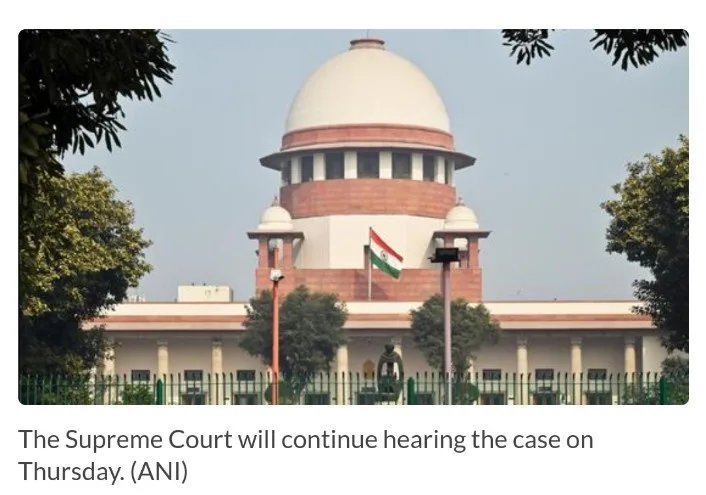
The hearing is set to continue on Thursday
Through the written submissions of solicitor general Tushar Mehta, the Centre on Tuesday informed the court that its decision in 2016 to withdraw its support for minority status to AMU was based on “constitutional considerations alone” because the previous UPA government’s stand to legally fight for it was “against public interest” and contrary to the public policy of reservation for marginalised sections.
Stressing that the change of government at the Centre was inconsequential to the reversal of the stance, the NDA government noted that the Union government should have never filed a separate appeal in the top court against the 2006 judgment of the Allahabad high court, which ruled that AMU is not and has never been a minority institution. The previous government’s stance was further in the teeth of a five-judge bench ruling in the Azeez Basha case in 1967, said the Centre, adding AMU is an institution of “national character” that ought to maintain its secular origins and serve the larger interest of the nation first.


