



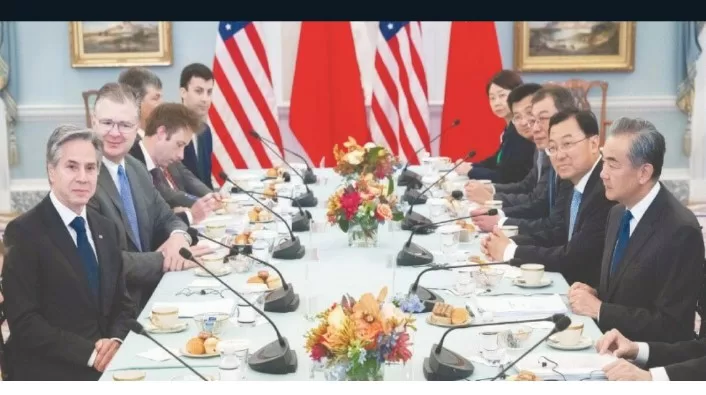
In a pivotal diplomatic move, President Joe Biden welcomed China’s Foreign Minister, Wang Yi, to the White House on Friday, marking a significant step towards preparing for a potential visit by Chinese President Xi Jinping to the United States. These diplomatic efforts come in a bid to ease tensions between the two economic giants.
The occasion for this gathering is President Biden’s invitation to President Xi for the upcoming Asia-Pacific Economic Cooperation (APEC) summit in San Francisco next month. However, the United States has maintained a firm stance on China, continuing sanctions and supporting its allies in disputes with Beijing.
During their meeting, President Biden conveyed to China’s Foreign Minister that it is paramount for Washington and Beijing to “manage competition in the relationship responsibly and maintain open lines of communication,” as stated by the White House.
Amidst the ongoing Israel-Hamas conflict in the Middle East, President Biden also emphasized the necessity for the United States and China to collaborate in addressing global challenges. While media coverage was restricted during the meeting, the White House released a photograph capturing the moment when President Biden and Wang Yi shook hands.
National Security Council spokesman John Kirby, speaking to reporters, clarified that there is no official confirmation of a meeting between President Xi and President Biden in San Francisco. Nevertheless, he regarded the hour-long discussion in the White House’s Roosevelt Room as a “positive development and a valuable opportunity to continue the dialogue.” The Israel-Hamas conflict and global issues such as climate change were among the topics on the agenda.
Wang Yi’s two-day visit to Washington also included meetings with Secretary of State Anthony Blinken and National Security Adviser Jake Sullivan, marking the latest in a series of high-level interactions between the two nations.
After his meeting with Secretary Blinken on the previous day, Wang Yi expressed his intention to “stabilize US-China relations” and “reduce misunderstanding” that has accumulated over the years. He acknowledged that differences would inevitably arise but asserted that China’s responses would be measured and guided by principles rather than the strength of arms or the volume of voices.
Notably, President Biden and President Xi had no contact since their last meeting in Bali in November 2022. Sino-American relations have been strained for several years as both nations compete for influence in the Asia-Pacific region and globally. Additionally, China’s growing cooperation with Russia to reduce US dominance has added to these tensions.
The United States and China have also engaged in verbal exchanges over the Middle East conflict, where the US has been a staunch ally of Israel. Among the sensitive issues in this relationship, the status of Taiwan, which Beijing claims, has been a prominent point of contention.