



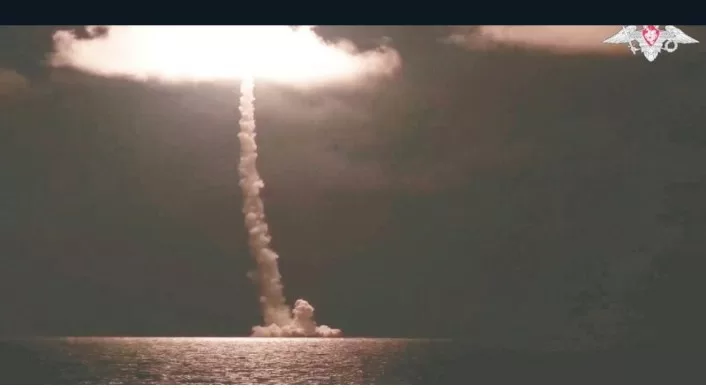
Russia’s recent accomplishment of a successful test of the Bulava intercontinental ballistic missile (ICBM) from its new strategic nuclear submarine, the Imperator Alexander III, was confirmed by the Russian defense ministry on Sunday. The Bulava missile, recognized for its capacity to carry up to six nuclear warheads, was launched from an underwater position in the White Sea off Russia’s northern coast. It accurately hit a target located thousands of kilometers away on the Kamchatka Peninsula in the Russian Far East, according to the defense ministry.
A statement from the ministry emphasized that the ballistic missile launch represents the concluding phase of state tests, following which a decision will be made regarding the inclusion of the cruiser in the Russian Navy.
The Imperator Alexander III belongs to the Russian Project 955 Borei (Arctic Wind) class of nuclear submarines, specifically, the fourth in the modernized Borei-A variant. These submarines, colloquially known as the Dolgoruky class, trace their origins to the Yuri Dolgoruky, the inaugural vessel of this new generation of Russian nuclear submarines post-Cold War.
Each Borei-class submarine is equipped with 16 Bulava missiles, with the 12-meter (40-foot) missile boasting an impressive range of approximately 8,000 kilometers (5,000 miles).
Since assuming power in 1999, President Vladimir Putin has substantially increased military expenditures and sought to rebuild Russia’s nuclear and conventional forces, a response to the upheaval that accompanied the fall of the Soviet Union in 1991.
The ongoing conflict in Ukraine has triggered the most profound crisis in Moscow’s relations with Western countries since the height of the Cold War. President Putin recently indicated his hesitance to make a definitive decision on whether Russia should resume nuclear testing.
In a televised interview on Sunday, Kremlin spokesman Dmitry Peskov conveyed that Russia’s relations with the United States have sunk to alarmingly low levels. “Relations are at zero — or I would say below zero,” Peskov remarked, though he acknowledged the inevitability of future communication between the leaders of Russia and the United States. He emphasized President Putin’s readiness for such interactions.
Russia’s objective is to construct a total of 10 to 12 Borei-class submarines, to be divided between the Northern and Pacific fleets, in accordance with the current plans disclosed by Russian media. The construction of three additional Borei-class submarines is currently underway, known as the Knyaz Pozharsky, the Dmitry Donskoy, and the Knyaz Potemkin. Furthermore, Russian media reports suggest that two more vessels of this class are in the planning stages.
The Bulava missile, with its impressive range of over 8,000 kilometers (approximately 5,000 miles), was designed to serve as the cornerstone of Russia’s nuclear triad.
Russia has faced accusations from the West of employing reckless nuclear rhetoric since the initiation of its offensive against Ukraine in February. Earlier this week, President Vladimir Putin signed a law rescinding Russia’s ratification of the Comprehensive Nuclear Test Ban Treaty, a move that drew strong condemnation from the United States.
The Comprehensive Nuclear Test Ban Treaty, established in 1996, prohibited all nuclear explosions, including live tests of nuclear weapons, although it never took effect because several key nations, including the United States and China, did not ratify it.
By Agencies