



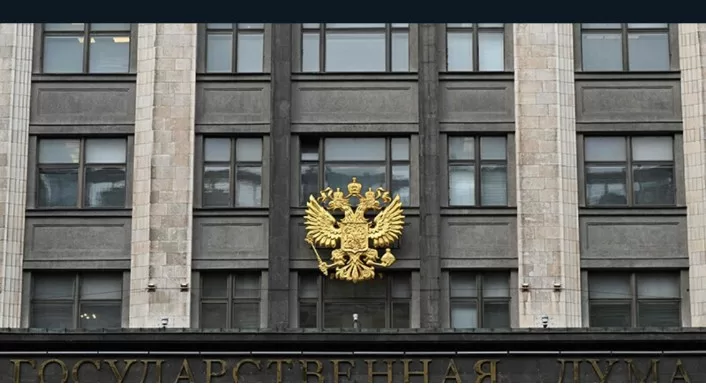
In a noteworthy development, Russia’s parliament initiated the process of revoking its ratification of the Comprehensive Nuclear Test Ban Treaty (CTBT) on Tuesday. Additionally, the top Russian lawmaker has issued a warning to the United States, suggesting that Moscow might consider abandoning the treaty entirely.
Moscow’s rationale behind this action is the pursuit of reinstating parity with the United States, which, despite signing the CTBT in 1996, has never formally ratified it. Russia emphasizes that it will not resume nuclear testing unless the United States takes similar steps.
While Russian authorities claim that this move is motivated by the desire to restore a balance, experts in arms control express concerns that this may pave the way for renewed nuclear testing. Such testing could herald a new era of nuclear power competition among global superpowers, a prospect the West perceives as a potential Russian nuclear escalation in the midst of the ongoing Ukraine conflict.
The State Duma, Russia’s lower house of parliament, voted unanimously, with 412 in favor and no abstentions, to approve the withdrawal of the CTBT ratification. Speaker Vyacheslav Volodin, a member of President Vladimir Putin’s Security Council, emphasized that this vote is a direct response to the U.S.’s perceived negligence of its global security responsibilities. He stated, “What we will do next — whether we remain a party to the treaty or not, we will not tell them. We must think about global security, the safety of our citizens and act in their interests.”
Volodin revealed that the United States had appealed to Russia, via the United Nations, not to revoke its CTBT ratification. He viewed Moscow’s decision as a necessary wake-up call for Washington, following its 23-year delay in ratifying the treaty, which Russia ratified in 2000.
The possibility of Russia resuming nuclear testing has been a topic of discussion, with some Russian security experts and lawmakers advocating for a nuclear test as a warning to the West. To date, North Korea remains the only nation to have conducted a nuclear explosion test this century.
While Russia is in the process of revoking its CTBT ratification, it has affirmed its commitment to remain a signatory to the treaty. Furthermore, it will continue to provide data to the global monitoring system that notifies the international community of any nuclear tests.
Post-Soviet Russia has refrained from conducting nuclear tests, with the last Soviet test taking place in 1990 and the United States in 1992. The resumption of nuclear tests by Russia, the United States, or China could potentially spark a new arms race among major global powers, marking a departure from the testing moratorium that followed the collapse of the USSR in 1991.
Andrey Baklitskiy, a senior researcher at the United Nations Institute for Disarmament Research, described Russia’s withdrawal from the CTBT as a concerning “slippery slope” toward resuming nuclear testing. He noted that President Putin had previously stated that Russia must be prepared to conduct a test if the United States does. In August, Russia’s Defense Minister Sergei Shoigu visited the Novaya Zemlya testing ground, located in a remote northern archipelago.
Recent satellite images published by CNN showed that Russia, the United States, and China have all constructed new facilities at their nuclear test sites in recent years.
While a Russian nuclear test may not be imminent, experts warn that taking steps in this direction diminishes the barriers to resumption. The specter of nuclear testing during the Cold War serves as a stark reminder of the dangers of nuclear brinkmanship, which has the potential to cause irrevocable harm to humanity and the environment.
The ongoing conflict in Ukraine has escalated tensions between Moscow and Washington to levels not seen since the Cuban Missile Crisis in 1962, all while China seeks to strengthen its nuclear arsenal as it rises as a global superpower.
President Putin has maintained that there is no need to revise Russia’s nuclear doctrine, which specifies that Russia would employ nuclear weapons only in response to an attack or if the state’s existence is threatened by conventional weapons.
Since the CTBT came into effect, there have been ten nuclear tests worldwide. India conducted two in 1998, Pakistan also conducted two in 1998, and North Korea carried out tests in 2006, 2009, 2013, twice in 2016, and in 2017, according to the United Nations.