


The world edged a small step closer to the end of the fossil fuel era on Saturday, but not by nearly enough to stave off the ravages of climate breakdown.
Countries meeting in Brazil for two weeks could manage only a voluntary agreement to begin discussions on a roadmap to an eventual phase-out of fossil fuels, and they did this incremental progress only in the teeth of implacable opposition from oil-producing countries.
The talks were hauled back from the brink of collapse in an all-night session into Saturday morning, after a bitter standoff between a coalition of more than 80 developed and developing countries, and a group led by Saudi Arabia and its allies plus Russia.
There was disappointment from campaigners, but relief that the talks had produced at least some progress. Developing countries achieved part of their goal at the global talks, which was a tripling of the financial support available from rich countries to help them adapt to the impacts of the climate crisis. They should receive $120bn a year for adaptation, from the $300bn developed countries pledged to them last year, but not until 2035, instead of the 2030 deadline they were demanding. Many had also hoped the increase would be on top of the $300bn.
A roadmap to the halting of deforestation was dropped from the final deal, a bitter disappointment for nature advocates at this “rainforest Cop” held in Belém, near the mouth of the Amazon River.
The agreement among 194 countries – excluding the US, which did not send a delegation – was reached in the early morning after 12 hours of nonstop extra-time talks among ministers in deserted conference halls, and completed at a closing meeting at 1.35pm, after negotiations were hauled back from the brink of collapse on Friday evening.
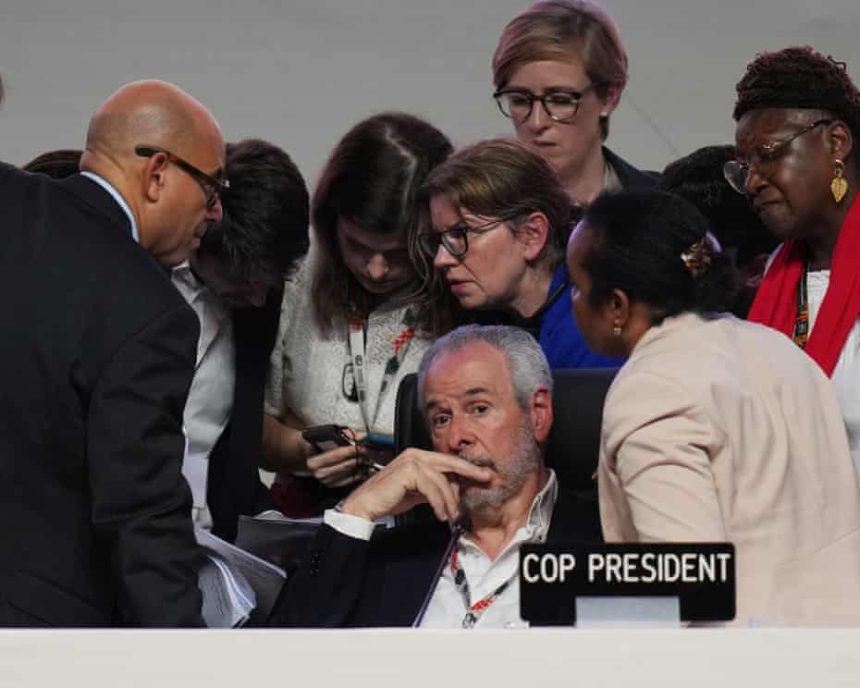
In the plenary, many country delegations, including Colombia, complained vociferously that they were not allowed to speak before the deal was gavelled through, despite Brazil having said this would be “Cop of truth”. The session was briefly paused but the Cop president, André Corrêa do Lago, then confirmed that the decisions that were gavelled through earlier had been adopted.
Jennifer Morgan, the Cop veteran and former German climate envoy, said: “While far from what’s needed, the outcome in Belém is meaningful progress. The Paris agreement is working, the transition away from fossil fuels agreed in Dubai [at the Cop28 talks in 2023] is accelerating. Despite the efforts of major oil-producing states to slow down the green transition, multilateralism continues to support the interests of the whole world in tackling the climate crisis.”
Mohamed Adow, director of the Power Shift Africa thinktank, said: “With an increasingly fractured geopolitical backdrop, Cop30 gave us some baby steps in the right direction, but considering the scale of the climate crisis, it has failed to rise to the occasion. Despite calling themselves climate leaders, developed countries have betrayed vulnerable nations by failing to deliver science-aligned national emission reduction plans.”
Aisha Humaira, Pakistan’s head of delegation, accused developed countries of hypocrisy: “Countries that have used all sources of energy in the last 200 years and have achieved the pinnacle of industrial growth and yet not stopped using all those sources of energy are telling us ‘stop growing,’” she said. “The right to growth and security is fundamental for every country.”
Efforts to limit global heating to 1.5C above preindustrial levels, in line with the goals of the Paris agreement, were also addressed in the final text, but less robustly than vulnerable countries had hoped. Before the conference, countries were supposed to present new national plans on cutting emissions, but they fell short of the commitments needed to maintain the 1.5C limit, which has already been breached but which analysts say could be returned to.
Instead of censuring this failure, the conference agreed to set up an “accelerator” programme to address the shortfall in the nationally determined contributions (NDCs), which will report back at next year’s Cop, to be held in Turkey but presided over by Australia. The text exhorted countries to “full implementation of NDCs while striving to do better”.
The final deal also recognised the “just transition” that social justice campaigners have been calling for, which means helping workers affected by the move away from fossil fuels and towards clean energy. But key provisions on the exploitation of “critical minerals” – which has been accompanied by soaring human rights abuses in some countries – were blocked by China and Russia.
Insiders said the talks came close to foundering on Friday, after a hectic few weeks in Brazil that began with a summit of world leaders held by Brazil’s president, Luiz Inácio Lula da Silva, and attended by about 50 heads or deputy heads of state.
But after the leaders left and Cop30 formally began on Monday 10 November, discussions among ministers and high-ranking officials degenerated into a bitter standoff. A fire near the delegation offices on Thursday afternoon, in which no one was seriously hurt, forced evacuation of the conference centre and disrupted negotiations at a crucial stage.
When they resumed late on Thursday evening, the rift was clear: more than 80 countries had declared in favour of including a commitment to “transition away from fossil fuels” in the final outcome, but scores of countries – led by the Arab group, which includes Saudi Arabia – lined up against it.
That opposition forced the relegation of the “transition away from fossil fuels” – that scientists say is essential to staving off the worst effects of climate breakdown – to a voluntary commitment rather than the legally binding decision many had hoped for.
Teresa Anderson, the global lead on climate justice at ActionAid International, said: “A lack of climate finance is throwing a spanner in the works of climate progress. Global south countries, [which] are already carrying the costs of the climate crisis they have not caused, desperately need support from rich countries if they are to take on any more commitments. Nowhere was this more stark than on the issue of fossil fuels, where specific text once again ended up unfunded and on the cutting-room floor.”
Nikki Reisch, from the Center for International Environmental Law, said: “This is an empty deal. Cop30 provides a stark reminder that the answers to the climate crisis do not lie inside the climate talks – they lie with the people and movements leading the way toward a just, equitable, fossil-free future.”