



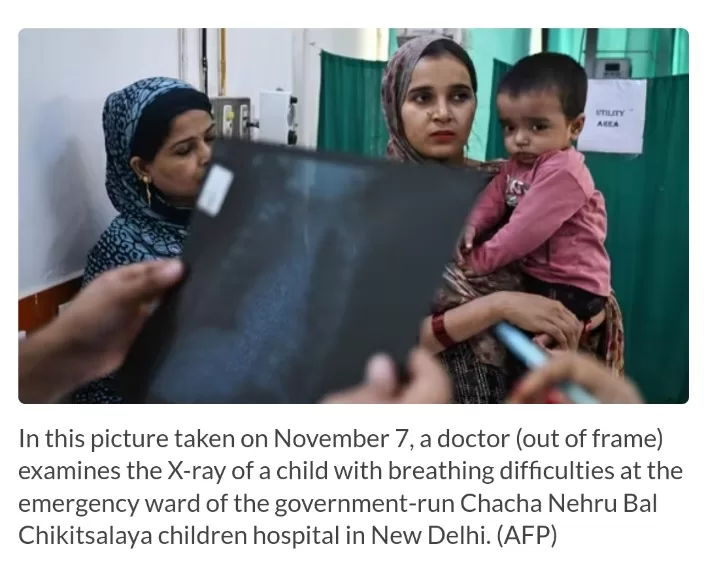
Delhi, India — The perennial air quality crisis in the national capital continues to vex its residents, as the Central Pollution Control Board (CPCB) reports that Delhi’s air quality remains firmly entrenched in the ‘severe’ category. This unrelenting issue persists despite numerous attempts to mitigate the pollution scourge.
In response to the deteriorating air quality, the Delhi government has announced a rescheduling of the December winter break for all schools. The break, originally slated for December, has been moved forward to run from November 9 to November 18. This move aims to protect the health and well-being of the city’s school-going children.
Concurrently, the neighboring state of Haryana has undertaken stringent actions against the practice of stubble burning. A total of 1,256 challans have been issued against offenders, resulting in fines exceeding ₹32 lakh, and 72 FIRs have been filed to address this pressing concern.
Delhi’s air quality reached the ‘severe’ category yet again, with the 24-hour average Air Quality Index (AQI) registering at 426. The mayor of Delhi, Shelly Oberoi, pointed out that open burning of garbage, the indiscriminate dumping of construction waste, and the use of tandoors in restaurants were among the primary contributors to the escalating air pollution in the national capital.
Recent updates on air quality in the Delhi NCR region include the following:
– Anand Vihar recorded an AQI of 432.
– RK Puram recorded an AQI of 453.
– Punjabi Bagh’s AQI stood at 444.
– ITO reported an AQI of 441.
– Ghaziabad reported an alarming average AQI of 443 at 6 AM, with the concentration of PM2.5 surpassing safe limits by seven to eight times.
– Sector-51 in Gurugram once again witnessed a ‘severe’ AQI, with a reading of 444.
In a novel approach to address the persistent smog crisis, Delhi authorities have unveiled plans to induce artificial rain to improve air quality. A proposal for cloud seeding, which employs substances like silver iodine to stimulate precipitation, is set to be presented to the Supreme Court. Notably, countries like China, Indonesia, and Malaysia have previously undertaken cloud seeding to alleviate pollution concerns. This attempt at artificial rain is scheduled for around November 20.
Furthermore, the odd-even car rationing scheme will be reintroduced in Delhi, pending the Supreme Court’s review of its effectiveness and subsequent orders.
The transport department has been directed to enforce the ban on app-based taxis, in line with the directives of the Supreme Court. However, it remains to be seen whether this ban will take effect immediately or solely during the implementation of the odd-even car rationing scheme.
According to the Haryana government, 90% of paddy harvesting in the state has been successfully completed, with efforts continuing to combat stubble burning.
Gautam Buddh Nagar district magistrate Manish Verma has issued instructions for industries and builders to bolster anti-pollution measures at their sites. Stringent action will be taken against those who violate National Green Tribunal (NGT) norms in Noida and Greater Noida. It is worth noting that, with certain exceptions such as hospitals and the Noida International Airport in Jewar, all construction activities in the district have been temporarily suspended.
As the battle against air pollution in Delhi intensifies, residents and authorities are striving to find innovative solutions to alleviate the ongoing crisis and ensure a healthier future for the city.