




In a harrowing event that has sent shockwaves through Morocco, a powerful earthquake with a magnitude of 6.8 struck the nation’s High Atlas mountains, leaving in its wake a grim tally of over 2,000 casualties. This seismic catastrophe, the most formidable to strike the North African country in a century, has cast a long shadow of despair as rescuers battle to reach the remote and hardest-hit areas, where countless lives still hang in the balance.
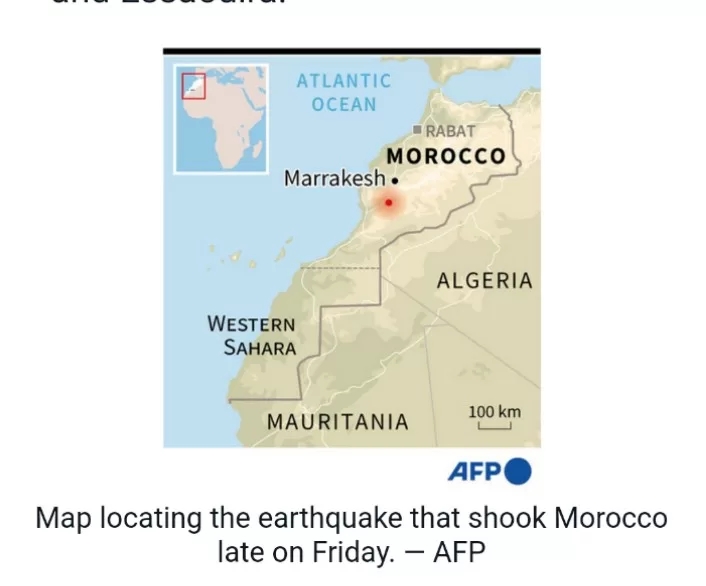
Morocco’s interior ministry reports a staggering death toll of at least 2,012 individuals, primarily concentrated in Marrakech and the adjacent provinces closest to the epicenter. Additionally, a further 2,059 individuals have sustained injuries, with 1,404 in critical condition. Regrettably, these numbers are expected to rise as access to the most affected mountain villages remains a formidable challenge, due to treacherous terrain and obstructed roads.
The World Health Organization (WHO) has declared that more than 300,000 people across the nation have been impacted by the devastating tremors, highlighting the extent of the crisis.
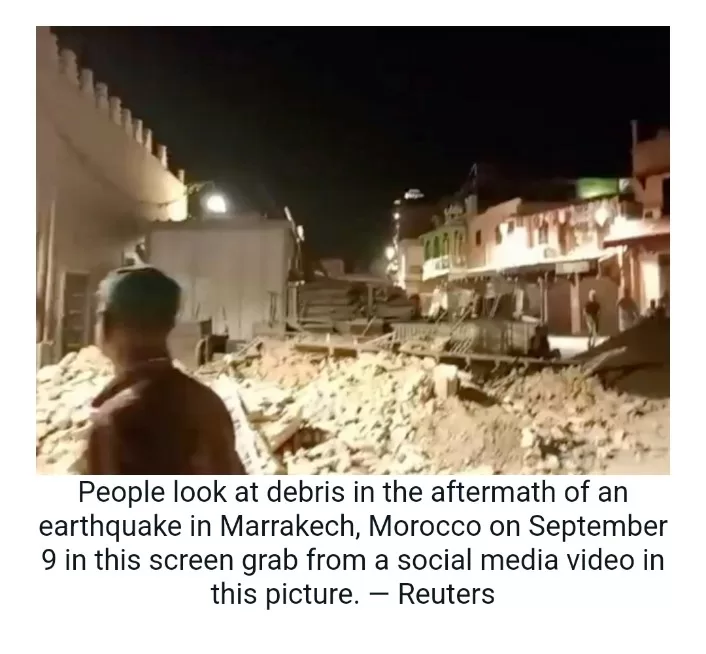
Marrakech, the largest city in proximity to the epicenter, witnessed the collapse of several buildings within its historic and UNESCO-designated old city. The renowned 12th-century Koutoubia mosque, an emblematic symbol of the city, suffered damage of uncertain magnitude. Initial reports indicate that a portion of the minaret overlooking Djemaa el-Fna, a bustling market square, crumbled, resulting in injuries to two individuals who sought refuge in the square.
Television broadcasts portrayed scenes of chaos in Marrakech, where debris and broken pipes littered the streets, with crushed vehicles obstructing thoroughfares. Fearful of aftershocks, residents resorted to sleeping in the open, wrapped in blankets.
Bill McGuire, a distinguished professor emeritus of geophysical and climate hazards at University College London, emphasized the vulnerability of buildings in regions unaccustomed to destructive earthquakes, underscoring the urgent need for more robust construction standards.
Terrifying eyewitness accounts underscore the trauma inflicted by this catastrophe. Fayssal Badour, a resident of Marrakech, recounted, “I was returning home when the earthquake struck. My car rocked back and forth, but I didn’t imagine for a single second this meant there was an earthquake happening. I stopped and I realized the catastrophe… it felt like we were on a river that suddenly burst its banks. The cries and the shouts were unbearable.”
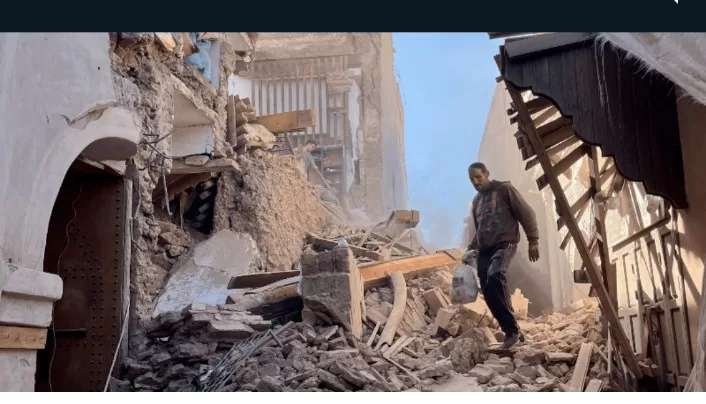
Local authorities have struggled to reach mountainous areas, where most of the casualties are concentrated. Morocco’s interior minister reassured the public that every available human and logistical resource is being mobilized, including specialized search and rescue teams. The Moroccan military, under the authorization of King Mohammed VI, is also actively involved in coordinating aid efforts, deploying rapid response units, aircraft, helicopters, drones, and logistical support to affected regions.
The earthquake, with a magnitude of 7.2 as reported by Morocco’s geophysical center and 6.8 according to the US Geological Survey, originated in the Ighil area, situated approximately 40 miles southwest of Marrakech. Its impact was felt at 11:11 PM, causing widespread devastation, particularly in Ighil’s small farming communities.
Marrakech’s historic old city bore the brunt of the damage, with collapsed houses and crumbling sections of the medieval city wall. Residents were seen removing debris by hand, awaiting heavy equipment assistance. The fear of further seismic activity compelled many to stay outdoors, braving the elements.
Reports of people fleeing their homes in Rabat, as well as the coastal town of Imsouane, resonated with the collective anxiety of a potential stronger quake. This sense of foreboding prompted gatherings in public squares and cafes, as citizens sought refuge from their damaged surroundings.
In this digital age, internet connectivity in Marrakech suffered due to power disruptions, impacting the ability to communicate and coordinate relief efforts.
Morocco’s location at the confluence of the African and Eurasian tectonic plates has historically made it susceptible to earthquakes. This recent catastrophe evokes memories of the 2004 earthquake in Al Hoceima on the northern coast, which claimed over 600 lives.
Remarkably, the seismic shockwaves reached neighboring Algeria and as far as Portugal, underscoring the widespread impact. Algeria, despite diplomatic tensions, has extended a gesture of solidarity, opening its airspace for humanitarian aid transport and offering resources to Morocco in its hour of need.
This tragedy serves as a stark reminder of the ever-present threat of natural disasters in regions prone to seismic activity, emphasizing the necessity for enhanced preparedness and resilience in the face of such catastrophic events.
AFP/Reuters