



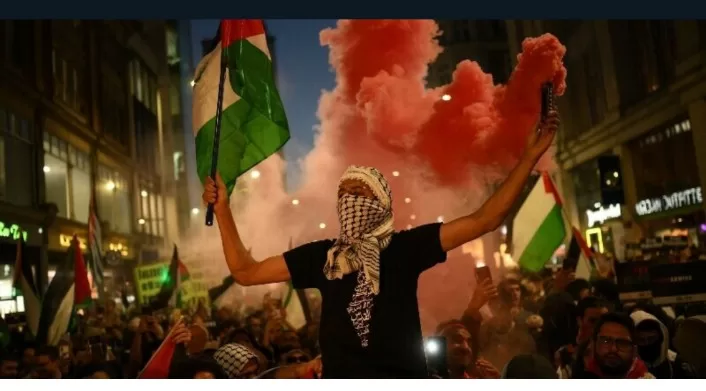
The enduring strife between Israel and Hamas, recently ignited by a surprise attack, stands as the latest chapter in a saga of seven decades of relentless conflict between Israelis and Palestinians, a quagmire that has entangled external powers and destabilized the broader Middle East. This conflict fundamentally juxtaposes the Palestinian yearning for statehood with Israel’s unyielding demand for security in a region it has historically viewed as hostile.
In a seminal moment on May 14, 1948, David Ben-Gurion, the founding father of Israel, declared the establishment of the modern State of Israel, providing a sanctuary for Jews fleeing persecution and fervently seeking a national homeland rooted in generations of historical connection to the land.
However, for Palestinians, this proclamation marked the Nakba, or “catastrophe,” leading to their dispossession and the dashing of their statehood aspirations. The ensuing war forced approximately 700,000 Palestinians, constituting half of the Arab population in British-ruled Palestine, to flee or be forcibly displaced, scattering them across Jordan, Lebanon, Syria, as well as the territories of Gaza, West Bank, and East Jerusalem. Notably, the assertion that Israel expelled Palestinians from their homes is contested by the nation, which highlights the fact that it was attacked by five Arab states immediately after its formation. Although armistice pacts brought an end to hostilities in 1949, a formal peace agreement remained elusive.
A significant population of Palestinians who remained in their homes during the conflict constitutes the Arab Israeli community, accounting for approximately 20 percent of Israel’s present-day population.
Major Wars that Shaped the Conflict
The year 1967 marked a pivotal moment as Israel launched a preemptive strike against Egypt and Syria, setting off the Six-Day War. Consequently, Israel has maintained its occupation of the West Bank, Arab East Jerusalem (captured from Jordan), and the Golan Heights (seized from Syria).
In 1973, Egypt and Syria initiated hostilities by attacking Israeli positions along the Suez Canal and the Golan Heights, leading to the Yom Kippur War. Within three weeks, Israel managed to repel both armies.
Israel’s military incursion into Lebanon in 1982 culminated in the evacuation of thousands of Palestinian fighters led by Yasser Arafat via sea after a 10-week siege. A resurgence of conflict in Lebanon occurred in 2006 when Hezbollah fighters captured two Israeli soldiers, prompting Israeli retaliation.
Although Israel withdrew from Gaza in 2005, which it had held since 1967, the region has witnessed significant escalations in violence in 2006, 2008, 2012, 2014, and 2021. These incidents encompassed Israeli airstrikes, Palestinian rocket attacks, and occasional cross-border incursions by both sides.
The conflict also witnessed two Palestinian intifadas or uprisings, occurring between 1987-1993 and again in 2000-2005. The second intifada saw waves of Hamas-perpetrated suicide bombings targeting Israelis.
Pursuits of Peace
Throughout the decades, various attempts have been made to bring about peace in the region. In 1979, Egypt and Israel inked a historic peace treaty, terminating three decades of hostility. The Oslo Accords, which offered limited Palestinian autonomy, were endorsed with a handshake between Israeli Prime Minister Yitzhak Rabin and Yasser Arafat in 1993. Jordan subsequently signed a peace treaty with Israel in 1994.
The Camp David summit in 2000, featuring President Bill Clinton, Israeli Prime Minister Ehud Barak, and Arafat, faltered in achieving a final peace agreement. In 2002, an Arab plan emerged, proposing normalized relations between Israel and all Arab nations in exchange for a complete withdrawal from the territories occupied in the 1967 Middle East conflict, the creation of a Palestinian state, and a “just solution” for Palestinian refugees.
However, peace initiatives have stagnated since 2014 when negotiations between Israelis and Palestinians failed in Washington. Subsequently, Palestinians boycotted interactions with the administration of then-U.S. President Donald Trump, who departed from decades of U.S. policy by declining to endorse the two-state solution.
Current Peace Endeavors
Under the administration of U.S. President Joe Biden, efforts have centered on securing a comprehensive Middle East agreement, encompassing the normalization of relations between Israel and Saudi Arabia, the guardian of Islam’s two holiest shrines.
The latest outbreak of conflict poses diplomatic challenges for Riyadh, as well as other Arab states, including some Gulf Arab nations adjacent to Saudi Arabia, which have entered into peace agreements with Israel.
The heart of the Israeli-Palestinian dispute revolves around four pivotal issues:
1. Two-State Solution: This entails an agreement that would establish a Palestinian state in the West Bank and Gaza Strip alongside Israel. Hamas, however, rejects this solution and is committed to Israel’s destruction. Israel maintains that a Palestinian state must be demilitarized to prevent any threat to its security.
2. Settlements: Most nations deem Jewish settlements constructed on land occupied by Israel in 1967 as illegal. Israel disputes this characterization, citing historical and Biblical ties to the land. The continued expansion of these settlements remains a contentious issue, sparking friction between Israel, the Palestinians, and the international community.
3. Jerusalem: Palestinians aspire for East Jerusalem, home to sites sacred to Muslims, Jews, and Christians, to serve as the capital of their state. Israel, conversely, asserts that Jerusalem should remain its “indivisible and eternal” capital. Internationally, Israel’s claim to eastern Jerusalem is not recognized. In 2018, former U.S. President Trump recognized Jerusalem as Israel’s capital without specifying its jurisdiction in the disputed city and moved the U.S. embassy there.
4. Refugees: Presently, around 5.6 million Palestinian refugees, primarily descendants of those displaced in 1948, reside in Jordan, Lebanon, Syria, the Israeli-occupied West Bank, and Gaza. Approximately half of these registered refugees remain stateless, often living in overcrowded camps. Palestinians have consistently demanded the right of return for refugees and their descendants. In contrast, Israel insists that any resettlement of Palestinian refugees must occur outside its borders.
By Reuters