



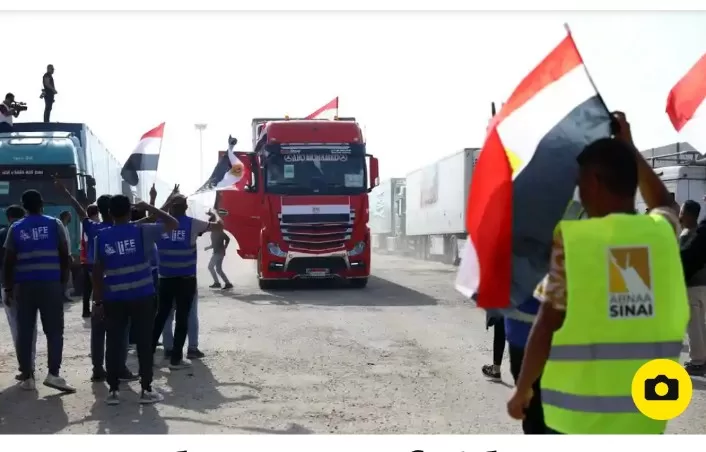
In a show of continued commitment to alleviate the dire humanitarian situation in Gaza, a second convoy of aid arrived on Sunday at the Egyptian side of the Rafah border crossing. The White House has assured that the aid flow will persist as Israel intensifies its bombardment of the embattled enclave.
President Joe Biden and Israeli Prime Minister Benjamin Netanyahu reached an agreement during a call, affirming their dedication to maintaining a steady supply of essential assistance into Gaza. The convoy, consisting of 14 trucks, was thoroughly inspected by Israeli authorities before entering Gaza, where the need for food, water, medicines, and fuel remains acute.
The United Nations has raised concerns over the meager volume of aid entering Gaza, amounting to just 4% of the daily average before hostilities erupted. As stocks of critical supplies dwindle, it is clear that more is required to address the growing humanitarian crisis.
COGAT, the Israeli defense body responsible for Palestinian civilian affairs, confirmed that the second batch of aid included vital provisions such as water, food, and medical supplies. Notably, fuel remains a contentious issue, with Israel yet to permit its entry into Gaza.
Even as aid reached Gaza, Israeli airstrikes continued to target the region, focusing on the central and northern areas, as reported by Palestinian media. Regrettably, areas close to three hospitals were struck early on Monday.
The toll of this two-week-long Israeli bombardment is significant, with Gaza’s health authority reporting over 4,600 casualties, including many women and children. The conflict originated when Hamas militants launched attacks on southern Israeli communities, resulting in the loss of 1,400 lives and the taking of 212 hostages.
In a statement released on Sunday, leaders from the United States, Canada, France, Germany, Italy, and Britain called on Israel to adhere to international humanitarian law and protect civilians while affirming their support for Israel’s right to self-defense. These appeals come amidst mounting concerns that the conflict could escalate into a broader Middle East crisis.
U.S. Secretary of State Antony Blinken and Defense Secretary Lloyd Austin expressed their expectation of the conflict expanding with the involvement of Iranian proxies. The United States has bolstered its presence in the Middle East with significant naval assets, including two aircraft carriers, support vessels, and around 2,000 marines, aimed at deterring attacks by Iran-affiliated groups.
Meanwhile, Palestinian Hamas leader Ismail Haniyeh and Iranian Foreign Minister Hossein Amirabdollahian discussed ways to halt Israel’s actions in Gaza, as indicated by Hamas. Israeli aircraft also targeted two cells of the Iran-backed Hezbollah group in Lebanon, according to the Israel Defense Forces (IDF).
As the conflict escalates around its heavily guarded borders, Israel has added 14 communities near Lebanon and Syria to its evacuation contingency plan in the north of the country. Prime Minister Netanyahu emphasized that if Hezbollah initiates hostilities, it would face devastating consequences.
The Israeli government has issued warnings to those remaining in northern Gaza, considering them “accomplices in a terrorist organization” as it intensifies its attacks on the region. The prospect of a ground offensive into Gaza looms, with tanks and troops positioned at the border, awaiting the command to proceed.
Furthermore, the World Health Organization has reported that seven hospitals in northern Gaza have been forced to close due to damage from airstrikes, power shortages, supply deficits, or Israeli evacuation orders. Medical professionals in Gaza have sounded the alarm, noting that hospitals are running low on medical supplies and fuel for generators, leading to makeshift measures, such as using sewing needles for surgeries and vinegar as a disinfectant.
Despite the arrival of a second aid convoy on Sunday, Cindy McCain, Executive Director of the U.S. World Food Program, emphasized that the situation in Gaza remains “catastrophic.” Before the conflict, 400 aid trucks entered Gaza daily, highlighting the urgent need for secure and sustainable access to feed the population.