



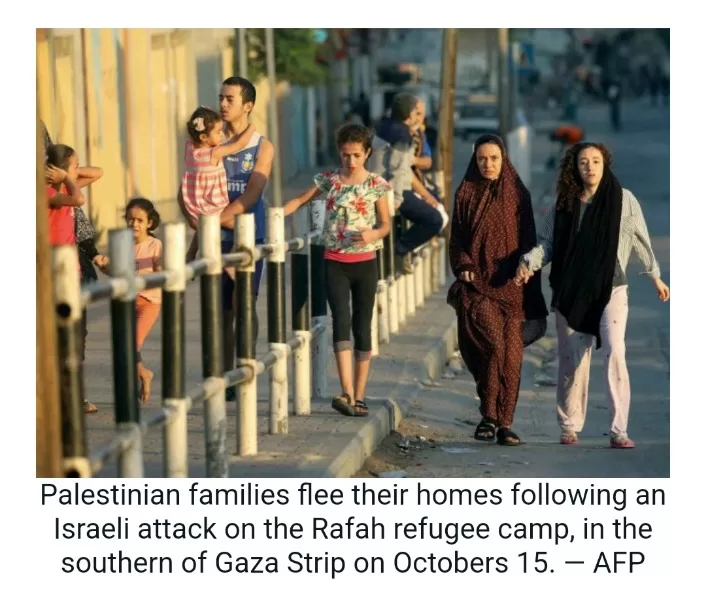
In a deeply distressing scene, a man wept openly as his home bore the brunt of Israeli airstrikes during a relentless series of bombings in southern Gaza, specifically in Khan Yunis. Fearing an impending Israeli ground incursion, Gazans hurriedly evacuated southward after stern warnings from the Israeli government.
The international stage is abuzz with news that U.S. President Joe Biden is actively considering a visit to Israel this week, a move that underscores the gravity of the situation. However, the details of the itinerary and whether additional stops will be made remain shrouded in uncertainty.
In an escalating series of demands, Hamas, the militant Palestinian group, called for the release of over 6,000 male and female prisoners in Israeli detention in exchange for hostages seized during their attacks initiated on October 7th. Prominently, these captives include high-ranking officers from the Israeli Defense Forces (IDF).
Hamas’s bold stance has prompted an unprecedented challenge to Israeli authorities, with around 200-250 Israeli hostages reportedly being held in Gaza, a figure that contradicts an earlier Israeli military statement claiming only 199 hostages.
The distressing plight of the hostages has been brought to light with the release of a video on Monday. This video showcases one of the captives, a woman whose injured arm receives medical treatment from an unidentified healthcare worker. In this heart-wrenching footage, she appeals for a swift reunion with her family.
The situation has become all the more perilous with Iran issuing a stark warning of a possible “pre-emptive action” against Israel in the coming hours. This looming threat is directly linked to Israel’s preparation for a ground invasion of the beleaguered Gaza Strip, a move that has long been warned by Tehran to invoke a broader conflict involving other nations.
U.S. Defense Secretary Lloyd Austin engaged in a conversation with his Israeli counterpart, Yoav Gallant, on Monday, emphasizing the United States’ commitment to de-escalate the Israel-Hamas conflict while prioritizing the safety of civilians.
Amidst these grim developments, the head of Israel’s domestic intelligence agency, Shin Bet, Ronen Bar, took responsibility for the devastating Hamas attacks that claimed the lives of over 1,400 people on October 7th. Bar’s focus remains resolute on the ongoing conflict, leaving investigations for a later date.
An intense diplomatic effort led by the United States has unfortunately fallen short of alleviating the suffering of two million Palestinians trapped amidst the relentless bombardment in Gaza. Essential supplies such as water, food, and medicine are fast running out, casting a shadow of a looming humanitarian catastrophe.
As the conflict rages on, the Gaza health ministry reported a distressing toll of at least 2,808 Palestinians killed and 10,850 injured since Israel initiated its attacks on the Gaza Strip. Furthermore, the Palestinian Journalists Syndicate decried the loss of 11 Palestinian journalists in Israeli airstrikes on Gaza.
The World Health Organization (WHO) sounded an alarm, warning of an imminent public health crisis as Gaza faces a dire shortage of water. The lives of over 3,500 patients in 35 Gaza hospitals hang in the balance. The WHO fervently calls for unimpeded access for humanitarian aid into this beleaguered enclave.
The United Nations relief agency for Palestine refugees (UNRWA) issued a grim statement, noting the dire lack of body bags for the deceased in Gaza. The region has endured five days without electricity, limited access to clean drinking water, and the displacement of over a million people.
In a dramatic turn of events, U.S. Secretary of State Antony Blinken and Israeli Prime Minister Benjamin Netanyahu were forced to seek refuge in a bunker for five minutes when air sirens blared during their meeting in Tel Aviv on Monday. In a joint press conference, Blinken pledged unwavering support for Israel, while Gallant warned of a protracted conflict ahead.
As tensions escalate, Israel has enacted a plan to evacuate residents living within 2km (1.2 miles) of the Lebanese border, in response to exchanges of fire with Hezbollah, running in parallel with the ongoing conflict in southern Israel involving Hamas. The evacuation plan encompasses 28 villages in the region.
The armed wing of Hamas, known as Al Qassam Brigades, unleashed a relentless “barrage of missiles” targeting Jerusalem and Tel Aviv. Their actions were framed as retaliation against Israel’s perceived targeting of civilians.
In a ray of hope, the European Union (EU) announced its intention to launch a “humanitarian air bridge” involving several flights to Egypt. The goal is to supply humanitarian organizations on the ground in Gaza with essential cargo, including shelter items, medicines, and hygiene kits.
Germany’s Chancellor, Olaf Scholz, has affirmed his plans to visit Israel this week, expressing solidarity with the embattled region. His focus lies in addressing practical concerns, particularly regarding the security situation and organizing humanitarian aid efforts.
Meanwhile, reports indicate that around 2,000 U.S. troops are preparing for potential deployment to support Israel. Their intended role is not combat-related but rather advisory and medical support, reflecting the gravity of the situation.
The crisis extends to British citizens, as two teenage sisters are believed to be held captive by Hamas following the attacks on southern Israel over the past weekend. These sisters, Noiya (16) and Yahel (13), are identified as victims, and their mother, Lianne, who hailed from Bristol, tragically lost her life during last Saturday’s harrowing events.
Tragically, the conflict has already claimed the lives of six Britons, with ten more individuals still missing in the aftermath of the Hamas assault on southern Israel a week ago. Chancellor Rishi Sunak has announced a substantial commitment of an additional £10 million in humanitarian aid destined for Gaza.
Across the globe, the brutal impact of the Israel-Hamas war is deeply felt, even beyond the immediate conflict zone. The heart-wrenching killing of a six-year-old Palestinian child in Illinois, characterized by local authorities as an Islamophobic hate crime, has sparked outrage and disbelief. President Joe Biden expressed his profound shock and revulsion at this horrific act, which is seen as a direct consequence of the ongoing Israel-Hamas hostilities.
Simultaneously, geopolitical tensions are on the rise as China and Russia, both former Cold War allies, adopt increasingly assertive positions in the Gaza conflict. This underscores the growing divergence between these two global powers and traditional Western allies, including the United States, the United Kingdom, and France.
In summary, the Israel-Hamas war, now in its eleventh day, continues to exact a heavy toll on both the immediate region and the international community. The need for a swift resolution and humanitarian intervention remains paramount to avert further suffering and loss of life.