



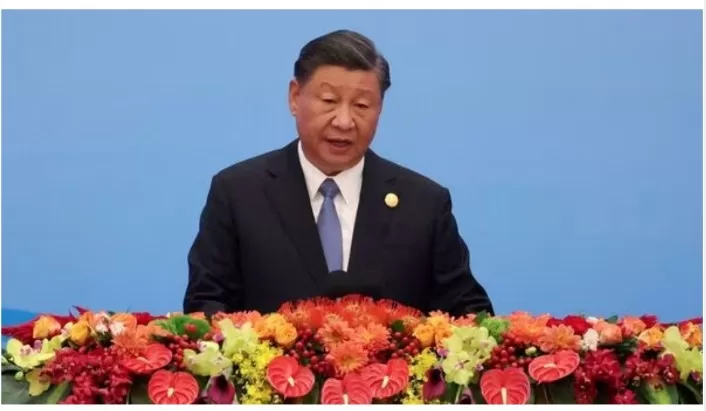
In a strategic move, President Xi Jinping is poised to strengthen his grip on China’s expansive $61 trillion financial sector. He will convene state leaders and top bankers during the closed-door, biennial Financial Work Conference, taking place in Beijing on Monday and Tuesday.
This assembly unfolds against a backdrop of several notable factors, including record low profit margins for the banking sector and a relentless anti-corruption campaign that has ensnared more than 100 officials and executives this year. Amid these circumstances, analysts and academics anticipate that Xi, China’s most influential leader since Mao Zedong, will prioritize the Communist Party’s “centralized and unified” leadership and enhanced oversight of the financial domain, placing these above all other policy objectives. Furthermore, the preservation of financial stability remains a paramount concern, aiming to avert the perils of an underperforming economy and potential disruptions in the property sector that could ripple into the banking sphere.
This conference carries immense significance and could potentially redefine the landscape of the financial sector, as noted by Bloomberg Intelligence economists led by David Qu. A burgeoning debt crisis in the property sector has heightened the sense of urgency surrounding this gathering.
The timing of this closely-watched assembly is crucial for China, especially amid growing scrutiny of the nation’s political and economic trajectory, partly fueled by Xi’s crackdown on various facets of the private sector. Foreign investors have been withdrawing capital from China at an unprecedented rate, and financial giants like Goldman Sachs Group Inc. have scaled back their ambitious expansion plans.
The Financial Work Conference, initially scheduled for the previous year but delayed due to China’s stringent Covid-zero approach, first emerged in 1997 in response to the Asian financial crisis. Its overarching objective is to advocate for financial reforms that stimulate economic growth and safeguard stability. In recent years, its prominence has grown significantly, with the previous iteration in 2017 presided over by Xi himself, contrasting with prior instances overseen by China’s premiers.
Several key topics are anticipated to dominate the agenda:
**Party Leadership:** Xi is likely to leverage this conference to emphasize recent modifications in financial industry oversight. Earlier in the year, the structure of financial industry oversight underwent an overhaul, including the creation of an expanded national regulatory entity and the transfer of certain responsibilities from the central bank to a Chinese Communist Party-controlled body. Sheng Songcheng, a former director of the People’s Bank of China’s statistics and analysis department, highlights the Party’s exertion of control through its anti-corruption drive and regulatory reforms, asserting that “the meeting will undoubtedly place the leadership of the Party’s Central Committee over all financial work at a prominent position.” Xi has also championed the financial sector’s compliance with his “common prosperity” agenda, pushing for reductions in salaries and curbing perceived excesses. Furthermore, the Party’s influence is bolstered through a concerted drive mandating that bankers study a plethora of volumes encapsulating Xi’s ideological thoughts.
**Stability & Risks:** It is of paramount importance for authorities to articulate a clear path for addressing debt concerns and averting a financial crisis. Regulators may adopt stricter oversight measures to mitigate moral hazards. Beijing has tasked major banks with shouldering some of the responsibility by extending credit support to beleaguered developers and local government financing vehicles carrying a staggering $9 trillion in debt. Their growing exposure has raised concerns among analysts regarding potential risks to systematically important banks. The Chinese authorities are likely to hold local governments accountable for resolving existing concealed debt and preventing the accumulation of new illicit liabilities.
**Financial Reform:** While financial stability takes precedence in the coming years, comprehensive institutional reforms of the financial system are improbable. This assertion comes from Raymond Yeung, chief economist for Greater China at Australia & New Zealand Banking Group Ltd. Nevertheless, the conference could culminate in a more precise allocation of responsibilities among the central bank, the National Administration of Financial Regulation, and the China Securities Regulatory Commission, constituting the financial oversight framework.
**Serving the Economy:** Policymakers may underscore the principle that the financial sector should primarily serve the real economy. This may result in a push for increased lending to strategic industries such as high technology, new energy, and environmental protection. Initiatives to bolster consumption and the service sector could also find a place on the agenda. Additionally, the meeting could advocate for more substantial support for high technology sectors and underprivileged areas such as agriculture and rural water projects.
Notably, China’s economy exhibited signs of improvement in the third quarter, with a 4.9% increase in GDP compared to the previous year. In September, retail sales surged by 5.5%, surpassing expectations and achieving the highest reading since May.
In conclusion, the conference may also offer insights into further opening up the financial sector and enhancing financial governance to navigate evolving global political and economic landscapes.