




In a high-profile civil fraud trial in New York, former US President Donald Trump took to the witness stand on Monday, delivering a sprawling and defiant testimony. During his appearance, he admitted that his company had inaccurately estimated the values of several of his assets, notably undervaluing the Mar-a-Lago estate and Doral golf course in Florida while overvaluing his Trump Tower apartment, among other holdings. Trump, however, downplayed the significance of these estimates, which state lawyers alleged were manipulated to secure more favorable financing terms, asserting, “It wasn’t important. You’ve made it important, but it wasn’t.”
Judge Arthur Engoron had previously declared these estimates as “fraudulent.” The State of New York, in its lawsuit, contends that these estimations misled lenders and insurers, resulting in substantial financial gains for Trump, around $100 million, and a gross exaggeration of his wealth by $2 billion.
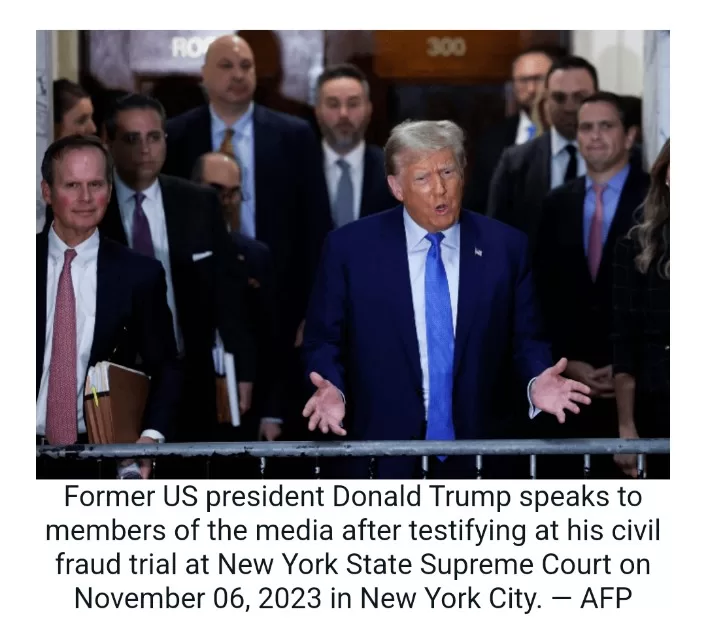
Throughout the trial, Trump has consistently labeled the case as a “witch-hunt” and accused Judge Engoron and New York Attorney General Letitia James of harboring political bias against him. On the witness stand, he continued to voice these complaints and expressed skepticism about a fair trial outcome, stating, “I’m sure the judge will rule against me because he always rules against me,” and adding later, “This is a very unfair trial.”
These comments prompted a stern rebuke from Judge Engoron, who threatened to curtail Trump’s testimony, urging his lawyer, Christopher Kise, to maintain control over his client and reminding Trump that the courtroom was not a political rally.
Attorney General Letitia James dismissed Trump’s attacks, emphasizing the importance of facts and numbers in the case, stating, “At the end of the day, the only thing that matters are the facts and the numbers. The numbers, my friends, don’t lie.”
It’s worth noting that unlike the criminal cases Trump faces, this civil trial does not pose a threat of imprisonment and is unfolding against the backdrop of his pursuit of a White House comeback bid.
Trump has sought to leverage these legal proceedings as part of his campaign efforts, using them to solicit campaign donations and argue that he is a target due to his political views. Nonetheless, this civil fraud case could potentially tarnish his longstanding image as a wealthy billionaire, renowned for his opulent resorts and prestigious golf courses bearing his name.
Attorney General Letitia James is pursuing $250 million in fines and is also seeking restrictions that would prohibit Trump and his sons, Eric and Donald Jr, from conducting business in their home state.
During the trial, both of Trump’s sons, Eric and Donald Jr, claimed they were unfamiliar with the specifics of the valuation documents. Trump echoed this sentiment, suggesting that accountants handled the majority of the valuation work.
Furthermore, Judge Engoron has previously revoked business certificates for companies that oversee significant portions of Trump’s business operations, although this ruling is pending appeal.
The evidence presented thus far in the trial has revealed attempts by company officials, including Trump’s sons, to manipulate the assessed values of prized properties such as the Mar-a-Lago estate in Florida.