



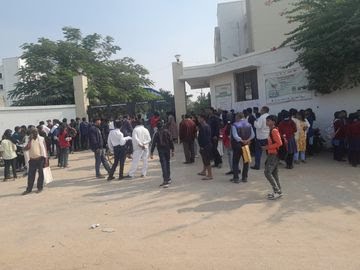
Patna, A state-owned engineering college constructed at a cost of nearly ₹98 crore and widely touted as one of Bihar’s most modern technical education institutions is facing sharp criticism for the glaring absence of basic external amenities, despite its sophisticated internal facilities.
Inaugurated in the 2019-20 financial year, Government Engineering College, Kaler – located barely a kilometre off National Highway 139 – was designed to serve as a flagship institution under Bihar’s science and technology department. With four engineering disciplines, the campus currently enrols over 1,000 students and regularly hosts state-level university examinations and competitive tests, turning it into a high-footfall centre.
Inside, the institution meets contemporary standards: air-conditioned classrooms, well-equipped laboratories, a digital library, and sports facilities set amid verdant, quiet surroundings. Yet the moment one steps outside the main academic block, the picture changes dramatically.
There are no public toilets in the outer premises, no drinking water points, no shaded waiting areas or benches, and no designated parking zone. The approach road – a narrow rural thoroughfare – becomes nearly impassable during the monsoon. During examinations, thousands of candidates and their guardians are forced to wait under the open sky, in scorching heat, rain, or winter chill.
The lack of toilets has emerged as the most egregious shortfall. Women candidates and accompanying family members, in particular, face acute distress and are sometimes compelled to relieve themselves in the open – an indignity that has drawn widespread public outrage in a country striving to improve sanitation and gender-sensitive infrastructure.
Vehicle congestion along the approach road and haphazard parking on adjoining fields routinely create traffic bottlenecks and raise safety concerns.
Principal Dr Pranav Kumar confirmed that academic and administrative operations inside the campus remain unaffected, but acknowledged the “serious deficiencies” in external infrastructure. He stated that a formal representation has been submitted to the District Magistrate and that remedial works are expected shortly.
Local residents and regular visitors have questioned why a project executed with a ₹98 crore outlay – funded largely through the Rashtriya Uchchatar Shiksha Abhiyan (RUSA) and state budget – could overlook such elementary civic amenities at the planning or execution stage.
The paradox of cutting-edge laboratories coexisting with the absence of basic sanitation and waiting facilities has become a talking point in Arwal and neighbouring Jehanabad districts, underscoring persistent gaps in project planning and last-mile execution that continue to plague even high-value public infrastructure initiatives in Bihar.