


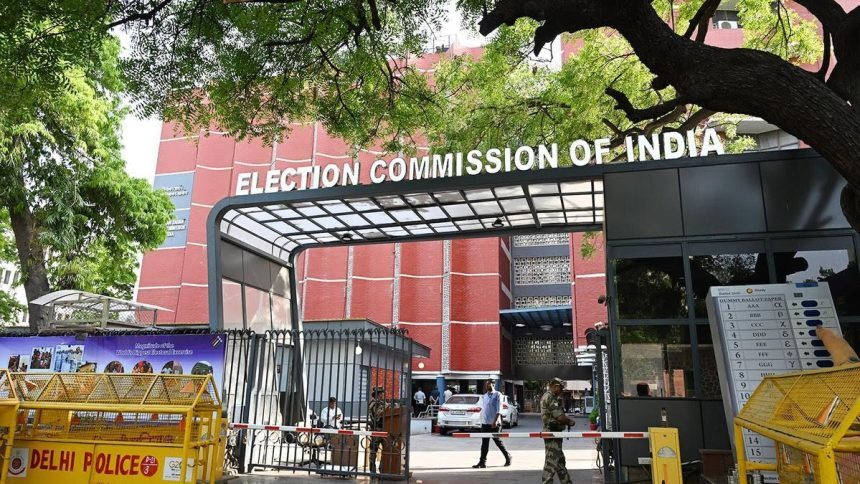
New Delhi, The Supreme Court of India on Thursday instructed the Election Commission (EC) to prepare detailed documentation rebutting allegations that its Special Intensive Revision (SIR) of Bihar’s electoral rolls failed to remove more than 500,000 duplicate entries.
A bench comprising Chief Justice Surya Kant and Justice Joymalya Bagchi heard submissions from Prashant Bhushan, appearing for the Association for Democratic Reforms (ADR), a non-governmental organisation focused on electoral transparency. Mr Bhushan told the court that duplicate names flagged by petitioner Yogendra Yadav during an October presentation to the bench remained on the final voter list published after the SIR exercise concluded.
The advocate accused the EC of “astonishing adamancy” in declining to run its own de-duplication software across the Bihar rolls, an action he argued would automatically eliminate the contested entries. He further criticised the revision process for lacking transparency, claiming the Commission had refused to disclose the methodology used for additions and deletions.
In response, the bench directed the EC’s counsel, Eklavya Dwivedi, to ensure all relevant records were ready for scrutiny. “The Election Commission must respond to these factual aspects,” the court observed, adding that the poll body was “required to demonstrate that it scrupulously followed the rules and regulations set by itself for the SIR”.
Mr Dwivedi informed the court that the EC had already filed an affidavit affirming full compliance with its own guidelines and prior Supreme Court directions.
Separately, Mr Bhushan contended that the EC lacked constitutional or statutory authority to adjudicate citizenship during the revision. He argued that where a Booth Level Officer harboured doubts about an elector’s nationality, the matter should be referred to the appropriate authority; pending a final decision (subject to judicial appeal), individuals affirming Indian citizenship by affidavit could not be struck off the rolls.
Senior advocate Shoeb Alam, appearing for another petitioner, submitted that while the EC enjoys general superintendence over elections, its powers remain circumscribed by statute.
In Parliament, Law Minister Arjun Ram Meghwal told the Rajya Sabha that responsibility for conducting the SIR rests solely with the Election Commission. He noted that India’s electoral rolls have undergone significant churn over the past two decades, driven by rapid urbanisation and internal migration for education and employment. Many voters, he said, register in new locations without deleting prior entries, contributing to duplication.
The case has spotlighted ongoing concerns about the integrity and accuracy of India’s voter database ahead of future state and national elections. The Supreme Court is expected to resume detailed hearings after the EC presents its evidentiary response.