



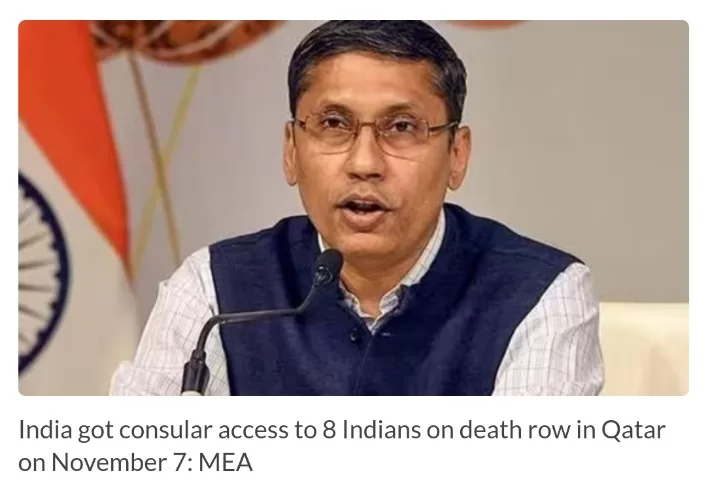
India firmly asserted that Australian authorities lack the legal jurisdiction to arbitrate in the matter of allegations brought forth by a former domestic employee of India’s erstwhile envoy to Australia, Navdeep Suri, concerning unpaid wages and working conditions. External Affairs Ministry spokesperson Arindam Bagchi, during a routine media briefing, emphasized that any grievances raised by the former service staff of the Indian high commission in Canberra should be appropriately addressed within the confines of Indian jurisdiction.
In response to Australia’s Federal Court instructing Suri to remit over AUD$136,000 (₹72.7 lakh) plus interest to the former domestic employee within 60 days, Bagchi reiterated India’s rejection of Australian authorities’ standing to adjudicate on matters concerning India-based service staff. Bagchi underscored that the individual in question had deliberately abandoned her post in May 2016, a day before her scheduled return to India, and possessed an official passport along with an Australian diplomatic visa.
Despite India’s persistent requests for the repatriation of the former service staff, Bagchi revealed that she had made allegations against the former high commissioner, resulting in an ex-parte judgment from the Australian court. Expressing concern, Bagchi conveyed that there are suspicions surrounding the individual’s motives, hinting at a desire to permanently reside in Australia, a goal she seemingly achieved by obtaining Australian citizenship in 2021.
India, perturbed by the ex-parte court ruling, has initiated dialogue with Australian authorities, urging them to uphold obligations under the Vienna Convention on Diplomatic Relations, particularly regarding diplomatic immunities and privileges. The Federal Court’s ruling, denying Suri foreign state immunity or diplomatic immunity, based on the assertion that a domestic worker’s engagement is not an official function, has been contested by the Indian side.