



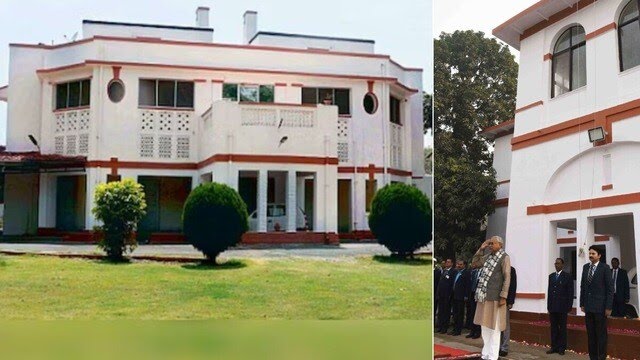
Patna, In the often fractious world of Bihar politics, where government bungalows are frequently reallocated amid coalition upheavals, one address has remained remarkably constant for nearly two decades: 1, Aney Marg, Patna – the official residence of the state’s chief minister.
For all but a brief interlude under Jitan Ram Manjhi in 2014-15, the sprawling colonial-era bungalow has been occupied since 2005 by Nitish Kumar, irrespective of whether his administration was anchored in the National Democratic Alliance or the rival Mahagathbandhan. The longevity is striking in a state where political fortunes can change overnight.
The street itself bears the name of Madhav Shrihari Aney (1880-1968), a Maharashtrian lawyer, independence activist and, briefly, the second Governor of Bihar from January 1948 to June 1952. Aney succeeded Sir Jairamdas Daulatram and served until ill health forced his return to Maharashtra.
A protégé of Bal Gangadhar Tilak, Aney was active in the Home Rule Movement and remained a prominent Congress figure until the 1930s, when he broke away with Madan Mohan Malaviya to form the Congress Nationalist Party. In the 1934 Central Legislative Assembly elections, the new party won 12 seats, finishing second behind Congress. During the Second World War, Aney served on the Viceroy’s Executive Council (1941-43) and subsequently as India’s High Commissioner to Ceylon (1943-47). Post-independence, he was a member of the Constituent Assembly and later twice elected to the Lok Sabha from Nagpur.
Aney is also remembered in Maharashtra for being among the earliest advocates of a separate Vidarbha state – a demand that resurfaced periodically but was ultimately rejected by the States Reorganisation Commission.
In Patna, however, his legacy is confined to the discreet signage of Aney Marg, a leafy avenue in the high-security zone near the Raj Bhavan. Few of the journalists and officials who pass the chief minister’s gate daily are aware that the name commemorates a governor who held office for just four-and-a-half years more than seven decades ago.
In an era when roads and public buildings across India are routinely renamed amid ideological battles, the continued use of “Aney Marg” stands as a minor historical curiosity – and perhaps a small mercy for Bihar’s postal department.