



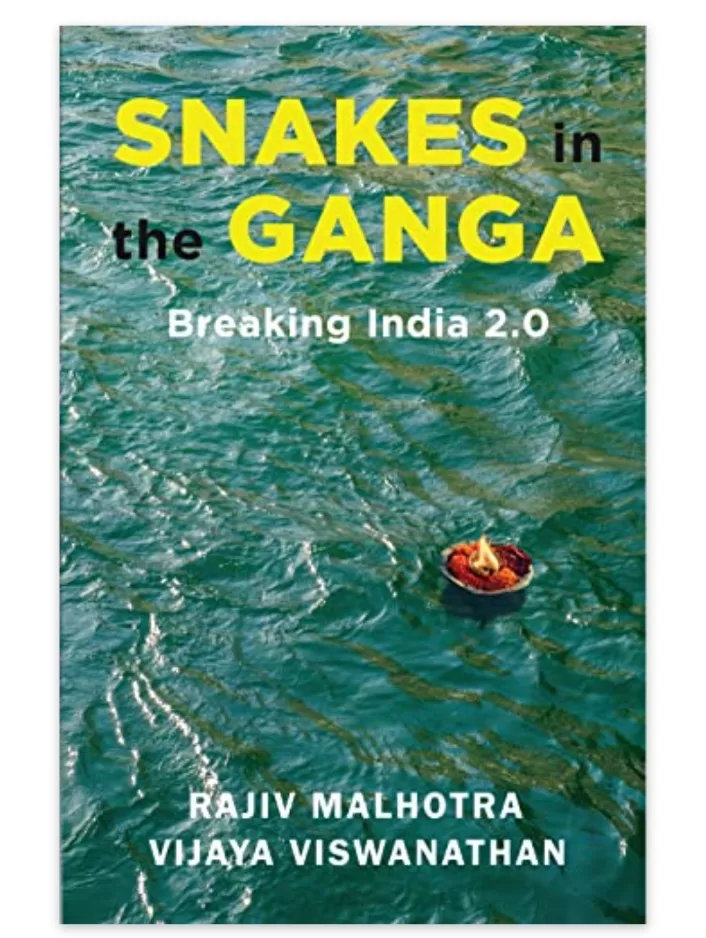
In a groundbreaking literary work, “Snakes in the Ganga: Breaking India 2.0,” authored by Shri Rajiv Malhotra and Mrs. Vijaya Viswanathan, India’s national security vulnerabilities receive a spotlight, particularly concerning the United States. While the common perception among Indians often points to threats from countries like Pakistan, China, and internal challenges like terrorism, illegal migration from Bangladesh, left-wing extremism, and Islamic radicalization, this book unveils the multifaceted dangers originating from the USA.
This comprehensive exploration, spanning 860 pages, with 63 pages of endnotes and a 59-page bibliography, reflects the authors’ extensive research into the inimical forces operating in the USA. The objective is to shed light on the various anti-Indian activities occurring there, identify the actors behind these activities, and propose countermeasures to thwart these “Breaking India” forces.
The title, “Snakes in the Ganga,” serves as a metaphor for concealed dangers. Just as the holy river Ganga appears tranquil on the surface, the book reveals that hidden beneath are vicious enemies of dharma. These threats emanate from the USA, often viewed as the land of opportunities by many Indians.
One of the central themes of the book revolves around the insidious concept known as “Critical Caste Theory.” Emerging from US academia, this theory equates caste with race and asserts that caste is the origin of American racism. According to this theory, caste originated in the Vedic tradition in India and was later adopted by the British in India, which subsequently influenced the framing of racial issues in the USA. This theory posits that caste is responsible for racism worldwide and serves as the blueprint from which various forms of racism emerge globally.
The authors argue that this narrative seeks to blame India for societal ills in the USA and Europe, thereby fostering division and animosity. These ideas, propagated in Ivy League universities like Harvard, gain credibility and acceptance among many Indians.
Furthermore, the book delves into how this narrative is being adopted and promoted in India, particularly in educational institutions and private universities, threatening India’s social fabric and stability. It emphasizes the urgent need to counter this narrative warfare originating from the USA.
The “Snakes in the Ganga” book not only identifies these hidden dangers but also provides a blueprint for countering these threats to India’s sovereignty and national security. It calls for a collective effort to clean up the Ganga before it is too late for India.
Authors Rajiv Malhotra and Vijaya Viswanathan, known for their rigorous research and intellectual contributions, have produced a thought-provoking and essential work that highlights the pressing need for India to safeguard its interests against external forces seeking to undermine its unity and integrity.