



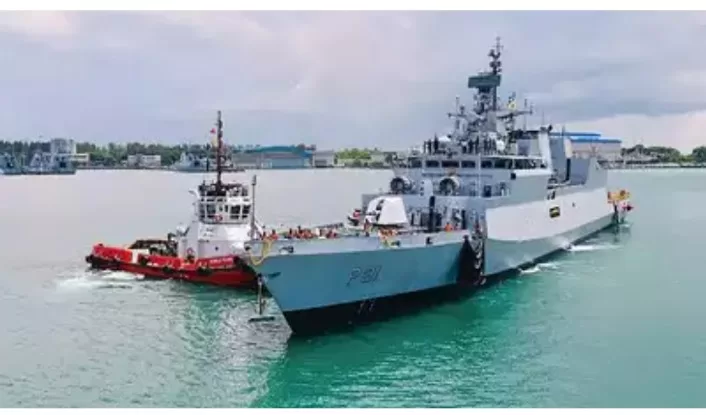
In a notable maritime endeavor directed towards South East Asia, India has dispatched two cutting-edge warships, a diesel-electric submarine, and a long-range maritime patrol aircraft to Singapore. This deployment is part of a strategic bilateral combat exercise aimed at enhancing military interoperability and cementing defense ties between the two nations.
The formidable Indian naval assets embarking on this mission include the guided-missile destroyer INS Ranvijay, the anti-submarine warfare corvette INS Kavaratti, the Kilo-class submarine INS Sindhukesari, and a P-8I aircraft. These vessels and aircraft will engage in joint combat exercises alongside the Republic of Singapore Navy (RSN) during the 30th annual “SIMBEX” exercise, a remarkable testament to the longstanding collaboration between the Indian Navy and RSN.
Commander Vivek Madhwal, Navy spokesperson, articulated the significance of this exercise, stating, “SIMBEX holds the distinction of being the longest continuous naval exercise that the Indian Navy has with any other country.” He further elucidated that the sea phase of this exercise would encompass intricate and advanced air defense maneuvers, gunnery firings, tactical maneuvers, anti-submarine warfare exercises, and other complex maritime operations.
This significant maritime deployment assumes particular importance within the context of India’s strategic concerns regarding an expansionist and assertive China. India has proactively bolstered defense cooperation with ASEAN countries such as Vietnam, Indonesia, Singapore, and the Philippines. This reinforcement includes joint military exercises, bilateral training programs, and military exchanges.
Furthermore, the inaugural ASEAN-India maritime exercise (AIME), conducted in May, involved warships from India, the Philippines, Indonesia, Singapore, Malaysia, Thailand, Brunei, and Vietnam. These naval forces collaborated in joint drills within the contentious South China Sea, where China’s territorial disputes with neighboring nations have garnered international attention.
India’s outreach extends beyond military exercises. The country has initiated arms supply agreements with ASEAN nations, exemplified by a $375 million deal with the Philippines for the supply of BrahMos supersonic cruise missiles. This strategic move is anticipated to pave the way for similar agreements with Indonesia and Vietnam, further enhancing regional security.
Singapore has played a pivotal role in India’s regional defense strategy. Through bilateral agreements forged over a decade ago, Singapore leverages Indian military facilities for its mechanized forces, artillery training, and the operation of F-16 fighter jets. Additionally, India and Singapore have formalized a naval pact that facilitates access to each other’s bases and mutual logistics support for warships, including submarine rescue operations.
In a gesture of strategic partnership, India recently gifted an indigenously-built missile corvette to Vietnam. This move is part of broader efforts to bolster Vietnam’s capabilities through training programs encompassing submarine operations, fighter jet activities, cyber-security, and electronic warfare.
As India continues to strengthen its defense and diplomatic ties with ASEAN nations, the maritime collaboration with Singapore underscores the nation’s commitment to regional stability and security. This strategic alignment remains a crucial element of India’s foreign policy in the dynamic geopolitical landscape of South East Asia.