


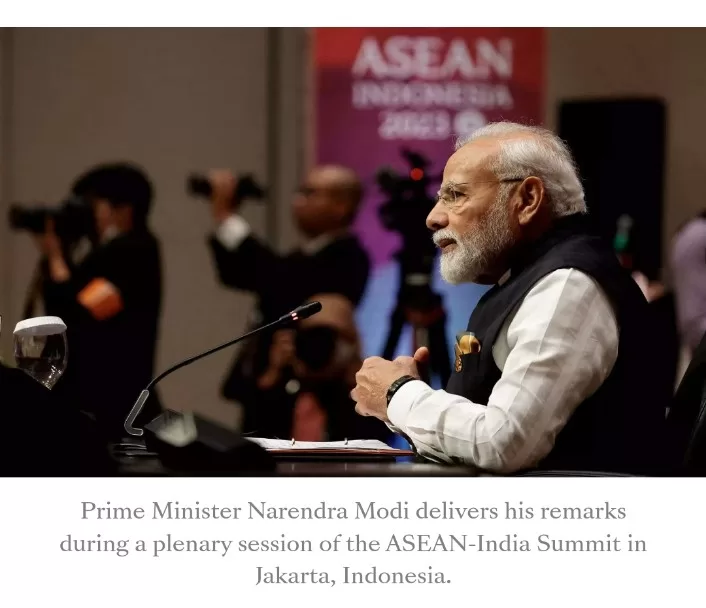
Prime Minister Narendra Modi delivered a significant address at the East Asia Summit, which took place in Jakarta during his official visit to Indonesia. In light of China’s increasing military assertiveness in the South China Sea, Prime Minister Modi underscored the imperative need for a united commitment and cooperative endeavors to strengthen the sovereignty and territorial integrity of all nations.
The current global landscape is fraught with complexities and uncertainties, cautioned the Prime Minister. During his speech, Modi articulated India’s firm belief in the imperative nature of a Code of Conduct in the South China Sea that is both effective and aligned with the principles of the United Nations Convention on the Law of the Sea (UNCLOS).
These statements come on the heels of strong reactions from multiple ASEAN member countries, including Malaysia, Vietnam, and the Philippines, in response to Beijing’s territorial claims over the South China Sea, as portrayed in its latest rendition of the “standard map of China.”
On August 28, Beijing unveiled the 2023 edition of this map, encompassing Taiwan, the South China Sea, Arunachal Pradesh, and Aksai Chin as Chinese territories. India promptly rejected this depiction and lodged a vigorous protest with China.
The Prime Minister underscored that all nations share a common interest in fostering peace, security, and prosperity in the Indo-Pacific region. “The need of the hour is an Indo-Pacific where international law, including UNCLOS (United Nations Convention on the Law of the Sea), applies universally; where there exists freedom of navigation and overflight; and where lawful commerce flows unimpeded, benefiting all,” expressed Modi.
He further emphasized, “India firmly believes that the Code of Conduct for the South China Sea should be effective, UNCLOS-compliant, and should also consider the interests of countries not directly involved in the discussions.”
Aridam Bagchi, the Ministry of External Affairs Spokesperson, took to X (formerly Twitter) to highlight Prime Minister Modi’s emphasis on the convergence of vision for the Indo-Pacific between India and ASEAN. Bagchi noted that Modi “underscored that ASEAN is the focal point of Quad’s vision” and called for strengthening multilateralism, ensuring a free, open, and rules-based Indo-Pacific.
The East Asia Summit, established in 2005, serves as the primary platform in the Asia-Pacific region for addressing security and defense issues. It has played a pivotal role in shaping the strategic, geopolitical, and economic landscape of East Asia. In addition to ASEAN member states, the East Asia Summit includes India, China, Japan, the Republic of Korea, Australia, New Zealand, the United States, and Russia.
Prime Minister Modi’s address underscored India’s commitment to promoting peaceful cooperation and international stability in a world grappling with terrorism, extremism, geopolitical conflicts, and challenging global issues such as climate change, cybersecurity, and food, health, and energy security. He emphasized that dialogue and diplomacy are the pathways to resolution in today’s era, emphasizing the significance of multilateralism and a rules-based international order.