



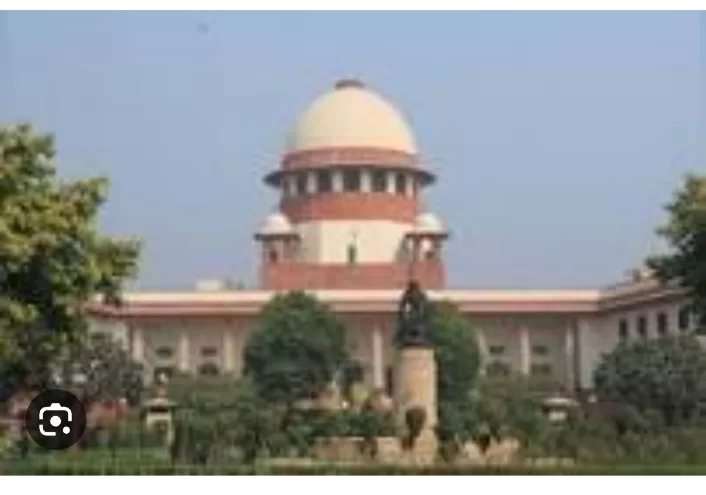
A metamorphic interrogation conducted by the eminent justices of the Supreme Court has cast an unanticipated spotlight on the contentious bifurcation of the border state, Jammu & Kashmir. This elaborate investigation, held within the purview of a cluster of petitions challenging the annulment of Article 370, has probed the very foundation of this bifurcation, scrutinizing its raison d’être in the light of analogous situations encountered by other regions of the nation. The hallowed corridors of justice resonated with the lucid elucidations of Chief Justice of India DY Chandrachud, who invoked profound inquiries into the conceptual underpinnings of this pivotal historical juncture.
The Supreme Court, through a legal deliberation marked as “Day 12” of the hearing, meticulously highlighted a salient facet that reverberates through the historical fabric. It posited a pivotal inquiry: Is Jammu & Kashmir truly a sui generis entity within the broader canvas of the Indian landscape? Chief Justice DY Chandrachud masterfully juxtaposed this with the remarkable revelations that Punjab and the Northeast have navigated through analogous scenarios, thereby summoning a palpable skepticism over the imperative of a partition that severed the bedrock of Jammu & Kashmir in August 2019.
In a scintillating dialogue that transpired within the court’s chamber, Solicitor General Tushar Mehta lent his legal acumen, emphasizing that the dynamics surrounding the bifurcation are intrinsically context-sensitive. The convergence of varying parameters comes into vivid play when dissecting the hypothetical bifurcation of states like Gujarat or Madhya Pradesh, distinguishing them from the complex chasm of circumstances embroiling Jammu & Kashmir.
Within this labyrinthine discourse, the esteemed Justice SK Kaul, an esteemed constituent of the five-judge constitutional bench headed by Chief Justice Chandrachud, offered an astute observation that reverberated through the courtroom’s precincts. He underscored the fact that the nation’s expansive topography is replete with states demarcated by borders, echoing that Jammu & Kashmir’s complex landscape isn’t the sole custodian of such intricacies.
However, the meticulous tete-a-tete witnessed a probing question that encapsulated the essence of checks and balances within governance. Chief Justice Chandrachud, with sagacious precision, examined the potential for the abuse of authority if the power to bifurcate a state were to be conferred to the Central government. This contemplation conjured profound contemplation on the mechanism to safeguard against the misuse of this pivotal prerogative, cascading into a profound dialogue on the parliamentary landscape’s role in settling such cardinal matters.
As the court proceedings continued, the discourse swerved towards a fundamental query that gnawed at the crux of the matter. “Does the hallowed parliament possess the constitutional authority to transform an existing Indian state into the status of a Union Territory?” queried Chief Justice Chandrachud, steering the contemplation towards the very core of India’s legislative foundation.
Further augmenting the deliberation, Justice Kaul eloquently established the contextual backdrop. He emphasized that the nuanced socio-political dynamics encountered within Jammu & Kashmir find counterparts in other terrains. The northern expanse of Punjab, historically enmeshed in turbulent times, and certain states within the northeastern ambit, echoed symphonies of analogous tumultuous trajectories. The reflection evoked the potential scenario where a plethora of states might face analogous quandaries, amplifying the significance of a discerning approach towards constitutional proceedings.