




The latest protest at Delhi’s Jantar Mantar should not be dismissed as just another “anti-reservation” demonstration.
On August 21, hundreds of people gathered under the banner of Reservation Hatao Andolan, an Instagram-led campaign with more than 5.6 million followers. Delhi Police detained several protesters after they gathered at Jantar Mantar despite permission having been granted for a demonstration at Ramlila Maidan. The protesters’ central argument was straightforward: government assistance should reach people who actually need it, and economic deprivation should have a greater role in determining eligibility for state support.
The movement has attracted considerable attention partly because it has brought an old and uncomfortable question back into the mainstream:
Can a reservation system created to correct historical disadvantage continue indefinitely without regularly measuring who is actually benefiting from it?
That is not an illegitimate question.
Nor does asking it amount to denying the historical discrimination that made affirmative action necessary in the first place.
A Debate That India Has Avoided for Too Long
Reservation is not an arbitrary government favour. It has constitutional foundations.
Article 16(4), for example, permits the State to make provisions for reservation in public employment for backward classes that are inadequately represented. The Supreme Court has repeatedly recognised that caste can be an important indicator of social backwardness.
But the constitutional framework itself does not demand that public policy remain frozen forever.
In Indra Sawhney, the Supreme Court accepted caste as a relevant determinant of backwardness while also establishing the principle that the creamy layer should be excluded from OBC reservation. The Court also developed the well-known 50 per cent ceiling in ordinary circumstances.
The reasoning behind the creamy-layer principle is particularly important.
If people who have already achieved substantial social and economic advancement continue to consume the same preferential benefits generation after generation, the policy risks failing the people at the bottom of the same category.
The Supreme Court itself has warned about precisely this problem: if the creamy layer is not excluded, the genuinely backward can remain backward while the benefits are captured by the more advanced sections.
That is not an argument invented by today’s anti-reservation protesters.
It is part of India’s own constitutional jurisprudence.
The Real Question: Who Is Getting the Benefit?
This is perhaps the strongest argument for a reservation audit.
India talks constantly about the percentage of seats reserved.
It talks far less about the distribution of those benefits within each reserved category.
Suppose two students belong to the same broad reserved category.
One comes from a family where the parents are highly educated, financially secure and have already benefited from reservation. The other comes from a family that has remained poor, has little educational capital and lives in an area with inadequate access to quality schools.
Treating their disadvantage as identical simply because they share a caste category may be administratively convenient.
But is it necessarily socially just?
The answer should come from data, not ideology.
This is why the demand for a comprehensive white paper raised by YouTuber and public commentator Ajeet Bharti at the Jantar Mantar protest deserves to be examined on its substance rather than the identity of the person making it.
Bharti called for a government white paper examining what reservation has achieved over roughly eight decades and questioned whether its benefits were reaching communities that remain among the most deprived. He specifically referred to the condition of the Musahar community in Bihar while making the case for examining distribution within reserved categories.
One does not have to agree with Bharti’s entire political or ideological position to agree with one basic proposition:
If the government has been implementing a policy for decades, it should be able to show who has benefited from it.
The OBC Category Shows Why One Label Cannot Tell the Whole Story
The OBC question is even more complicated.
“Other Backward Classes” is not a single homogeneous social group. It contains a very large number of communities with dramatically different histories, levels of education, economic conditions, political influence and geographical circumstances.
The official system itself demonstrates how complicated this can become.
The National Commission for Backward Classes maintains a state-wise Central List of OBCs, while states maintain their own lists and classifications for state-level benefits.
That means backward-class status is not necessarily identical across India’s federal system.
The history of the Jat community offers a useful illustration. Jats have been included in different OBC lists in different states and at different points in time. In 2013, the Union government approved the process for inclusion of Jats in the Central OBC List for several states, noting that they were already included in state OBC lists in nine states. The 2014 Central notification was subsequently struck down by the Supreme Court in 2015.
Delhi’s own OBC Commission also records that Jats were added to Delhi’s OBC list in 2000.
This is not an argument that any particular community is “undeserving”.
It demonstrates something more fundamental:
Backwardness is administratively and geographically complex.
A community cannot be assumed to have exactly the same social and educational condition everywhere in India.
That makes periodic, evidence-based review essential.
When the Most Organised Become the Most Visible
There is another problem that policymakers should be willing to confront.
The ability to demand reservation is itself unequal.
A large, politically organised community has greater capacity to mobilise, protest, negotiate with governments and influence elections than a small community with little political representation.
This creates a potential paradox.
A policy intended to protect the most disadvantaged can become increasingly influenced by groups that are better organised and more politically powerful.
India has already witnessed major political movements around demands for inclusion in backward-class categories.
That does not prove that such demands are illegitimate.
It does prove that political pressure cannot substitute for independent measurement of backwardness.
The question should always be:
How disadvantaged is the group?
How inadequate is its representation?
Who within that group is actually receiving the benefit?
And who is being left behind?
The Supreme Court’s 2024 judgment in State of Punjab v. Davinder Singh is significant in this broader context because it recognised the constitutional possibility of sub-classification within Scheduled Castes, subject to justification through relevant data.
The underlying principle is worth extending into the policy debate:
Broad categories should not become excuses for ignoring internal inequality.
Economic Poverty Deserves More Attention
The strongest criticism of the present system comes from a simple observation: poverty is not exclusive to one caste.
A poor child from a non-reserved community can face inadequate schooling, inability to afford coaching, poor nutrition and limited access to educational networks.
That child does not become economically secure simply because his or her caste falls outside a reservation category.
India already recognises economic disadvantage to some extent through the Economically Weaker Sections (EWS) framework. At the Central Government level, EWS is a separate reservation category for people not covered by SC, ST and OBC reservation.
The existence of EWS itself demonstrates that India’s affirmative-action debate has already moved beyond a purely caste-based framework.
The question now is whether the two approaches should be treated as competing ideologies—or whether they can be intelligently combined.
Caste can remain a measure of historical and social disadvantage.
Economic and educational deprivation can measure present-day disadvantage.
Neither necessarily has to cancel the other.
But Economic Criteria Alone Are Not Enough
This is where the debate needs intellectual honesty.
Replacing caste entirely with income would also be an oversimplification.
Caste discrimination is not merely an income problem.
Two families with identical incomes can experience different forms of social exclusion, discrimination and access to institutions.
That is why the Supreme Court has historically rejected the idea that economic criteria alone can simply replace the social dimension of backwardness under Articles 15(4) and 16(4). At the same time, the Court has recognised that economic disadvantage can justify affirmative state action through other constitutional routes.
So the serious reform argument is not:
“Remove caste and look only at income.”
It is:
“Measure disadvantage more intelligently.”
That could mean considering caste, parental education, household economic status, occupation, geography, school quality, first-generation college status and other measurable indicators—depending on the particular programme.
Reservation Cannot Become a Substitute for Good Schools
There is an even deeper problem.
Reservation treats the symptoms of unequal opportunity. It does not necessarily eliminate the causes.
If a child from a poor rural family needs reservation because the local school provides a dramatically inferior education, the long-term answer cannot simply be to reserve a seat for that child twenty years later.
The answer is to improve the school today.
If students need expensive coaching to compete for professional courses, the government should also ask why public schooling and affordable academic preparation are inadequate.
If some communities remain severely underrepresented after decades of affirmative action, policymakers should ask what barriers are preventing their children from reaching the point where a reserved seat can actually be used.
A reservation seat is useless to a child who never gets the educational foundation needed to compete for it.
This is why reservation policy must be connected to school education, scholarships, nutrition, coaching support, digital access and local economic development.
And Then There Is the Politics of Historical Grievance
India’s reservation debate is increasingly taking place alongside another disturbing trend: the transformation of historical grievances into contemporary community hatred.
History matters.
Caste discrimination matters.
The oppression experienced by communities over generations cannot simply be erased by declaring that everyone is equal today.
But neither can a person born in 2026 be held personally responsible for the actions of people who lived centuries ago.
A democratic society cannot permanently distribute guilt by ancestry.
Nor should every contemporary political dispute be converted into a battle between communities.
Yet populist politics often finds this division useful.
It is easier to mobilise voters around anger against another community than around the slower, less glamorous work of fixing government schools, creating jobs, improving policing, reforming universities and making welfare delivery transparent.
The danger is obvious.
When caste becomes a permanent political identity, reservation can stop being merely a policy instrument and become a source of political mobilisation in itself.
And when resentment against reservation becomes resentment against an entire community, the reform movement becomes equally destructive.
India needs neither caste romanticism nor caste hatred. It needs institutional reform.
What a Reform Agenda Could Look Like
A serious reform does not need to begin with abolishing reservation.
It should begin with measuring it.
The government should publish a comprehensive reservation and affirmative-action white paper containing decades of available data and clearly identifying:
- Which communities have benefited most from reservation?
- Which communities remain severely underrepresented?
- How many beneficiaries are first-generation beneficiaries?
- How concentrated are benefits among particular families or sub-groups?
- How effective has reservation been in improving educational and employment outcomes?
- Which communities remain trapped at the bottom despite decades of affirmative action?
- Where are economic and educational deprivation most severe?
The government should also strengthen mechanisms for sub-classification within broad categories where evidence demonstrates significant internal inequality.
The creamy-layer principle for OBCs should be reviewed and enforced consistently. The Supreme Court’s recent jurisprudence has also emphasised that OBC creamy-layer determination cannot be reduced mechanically to parental income alone; the broader status-based criteria matter.
Most importantly, reservation policy should be accompanied by universal programmes that address poverty and educational deprivation regardless of caste.
A poor child should not have to belong to the “right” caste to receive help with tuition, coaching or higher education.
The Reservation Debate Needs Less Outrage and More Data
The Jantar Mantar protest has provided India with an opportunity.
The government can dismiss it as an anti-reservation movement.
Opponents can dismiss everyone participating in it as privileged.
Both responses would be intellectually lazy.
The better response would be to ask the protesters a difficult question:
What exactly should replace the present system?
And then ask supporters of the existing system an equally difficult question:
Can you demonstrate, with credible data, that the present system is reaching those who need it most?
Those are legitimate questions on both sides.
A country aspiring to become a developed economy cannot be afraid to audit its own policies.
Reservation was created as an instrument of social justice.
If parts of the system are no longer achieving that objective efficiently—or if benefits are becoming concentrated among sections that are already relatively advanced—then reform is not betrayal.
Reform may be the only way to preserve the legitimacy of affirmative action itself.
India does not need a politics of “reservation versus merit.”
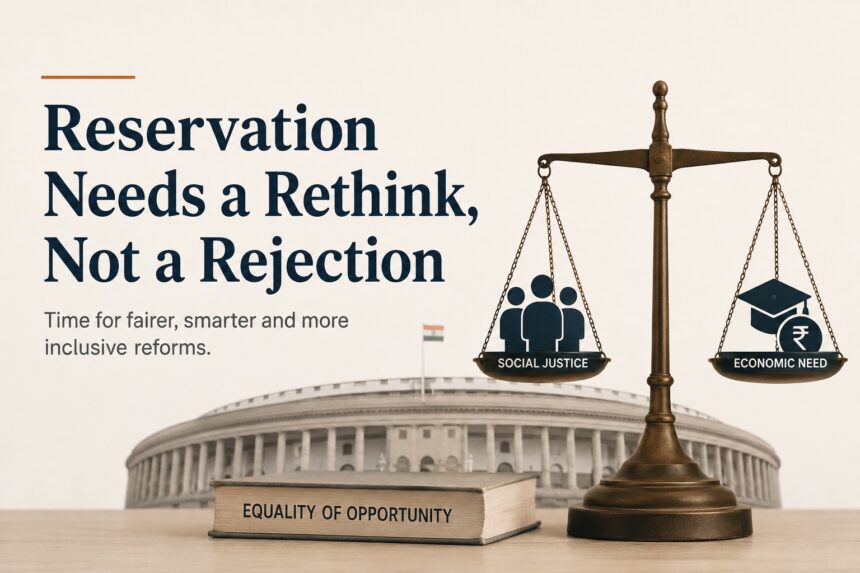
It needs a system in which social justice, economic need and equality of opportunity reinforce one another rather than being forced into permanent conflict.
The objective should ultimately be simple:
Not to ensure that one caste wins over another.
Not to punish one generation for the sins of another.
Not even to make reservation permanent.
But to build an India where a child’s future depends progressively less on the circumstances into which he or she was born.
That is a much harder goal than simply defending or abolishing reservation.
It is also a far more worthwhile one.

