



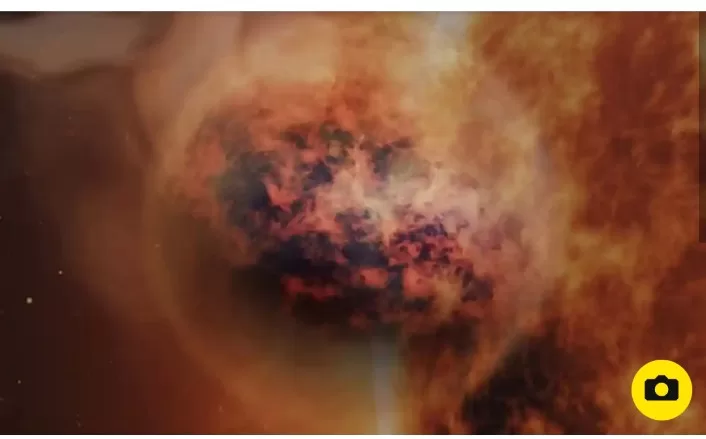
In a groundbreaking revelation, NASA’s James Webb Space Telescope has provided unprecedented insights into the atmospheric composition of a distant planet, known as Wasp-107b, where peculiar weather patterns include rain in the form of silicate sand. Situated 200 light years away in the Virgo constellation, Wasp-107b, often referred to as the “candy floss” planet due to its large yet lightweight nature, exhibits a host of distinctive features beyond the boundaries of our solar system.
The James Webb telescope, which utilizes advanced techniques to analyze starlight filtered through the planet’s atmosphere, discovered Wasp-107b in 2017. The periodic flickering of light from its host star, akin to a “fly in front of a street lamp,” facilitated the initial detection. Unlike conventional observations, this telescope allows scientists to delve into the chemical composition of distant atmospheres by interpreting the spectrum of starlight, offering valuable insights into the presence of various gases.
Wasp-107b, possessing a mass similar to Neptune but a size almost equivalent to Jupiter, has a vast and diffuse nature that enables the James Webb telescope to penetrate deep into its atmosphere. Dr. Joanna Barstow, a planetary scientist at the Open University, emphasized the significance of studying such “fluffy” planets, highlighting the ability to obtain substantial atmospheric signals.
The latest findings, published in Nature, showcase the presence of water vapor and sulphur dioxide, imparting a distinct scent reminiscent of burnt matches to the atmosphere. Notably, the study marks the first identification of chemical compositions within clouds on a distant planet, revealing the existence of silicate sand clouds.
Wasp-107b’s atmospheric dynamics parallel Earth’s water cycle, with sand transitioning between gaseous and solid states. In the scorching temperatures exceeding 1,000 degrees Celsius, silicate vapor rises from the lower atmospheric levels, forming microscopic sand grains upon cooling. Eventually, these sand clouds condense, resulting in a rain-like phenomenon descending to lower atmospheric layers. Below a specific threshold, the sand sublimates back into vapor, completing this intricate atmospheric cycle.
Despite the fascinating discoveries, Wasp-107b is not considered a candidate for life due to its hostile climate, marked by searing temperatures and the absence of a solid surface. However, the detailed insights obtained from such distant planets, particularly their atmospheric analyses, contribute valuable data for future exploration and understanding the diversity of celestial bodies beyond our solar system.
Professor Leen Decin, the first author of the research from the Catholic Institute (KU) Leuven, stressed the need to broaden our understanding of potential alternative conditions for life to form on other planets, envisioning possibilities distinct from Earth’s known parameters.