



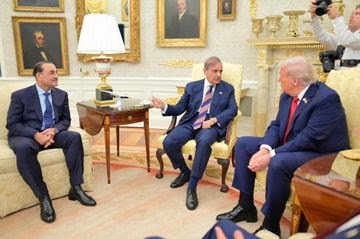
Washington, DC – Forty-four members of the US Congress have written to Secretary of State Marco Rubio calling for immediate sanctions on Pakistan’s Prime Minister Shehbaz Sharif and Chief of Army Staff General Asim Munir, citing what they describe as a deepening “authoritarian crisis” and systematic human-rights violations in the country.
The bipartisan letter, led by Democratic Representatives Pramila Jayapal and Greg Casar, accuses Pakistan’s military establishment of effectively running a shadow government while suppressing dissent, abducting critics, and rigging the February 2024 general election. The lawmakers argue that the current civilian administration functions as a “puppet regime” controlled by the armed forces.
Specific allegations include the abduction of relatives of US-based Pakistani journalists who criticised the military, the harassment of opposition figures, and the use of military courts to try civilians – a practice enabled by the controversial 27th Constitutional Amendment passed last month. The letter highlights the case of Ahmad Noorani, a Virginia-based investigative journalist, whose two brothers were allegedly kidnapped in Pakistan for over a month after he exposed military corruption.
The proposed measures fall under existing US legislation, notably the Global Magnitsky Human Rights Accountability Act, and could include:
– Comprehensive visa bans preventing the targeted officials and their immediate family members from entering the United States
– Freezing of any assets held in US jurisdiction or in financial institutions subject to US authority
The congressional intervention comes against the backdrop of unusually warm engagement between the Trump administration and General Munir. The army chief has met President Donald Trump twice this year – in June and again in September alongside Prime Minister Sharif – despite growing criticism of Pakistan’s domestic crackdown.
Lawmakers also renewed calls for the release of former prime minister Imran Khan and hundreds of other political prisoners, warning that continued repression risks further destabilising Pakistan and the wider region.
While the State Department has previously expressed “serious concerns” over irregularities in the 2024 elections, it remains unclear whether the Trump administration will act on the congressional request. Observers note that Washington continues to view the Pakistani military as an important – if problematic – partner on counter-terrorism and regional security issues.
The letter marks the strongest push yet by Capitol Hill to link future US assistance and high-level engagement with Islamabad to tangible improvements in democratic governance and human rights.